Good concrete surface prep is the difference between a coating that lasts and one that peels. Here is how concrete surface prep really works in Florida.
If you have ever watched an epoxy garage floor or warehouse coating peel up in sheets a year after it went down, the coating almost certainly was not the problem. Concrete surface prep for epoxy is where these jobs are won or lost, and in Florida the climate punishes shortcuts that might slide in a drier state. A coating is only ever as good as the concrete it grips, and getting concrete ready to grip takes more than a broom and a degreaser. This is the part of the job nobody photographs, and it is the part that decides whether your floor lasts a decade or a season.
Why Concrete Surface Prep Decides the Job
People assume a clean slab is a ready slab. It is not. A troweled or power-floated concrete surface is smooth and often sealed at the top by the finishing process, and a coating laid on that glassy surface has nothing to bite into. What coatings need is profile – a uniform, slightly roughened texture, like fine sandpaper, that multiplies the surface area and gives the epoxy a mechanical grip. The coatings industry even has a scale for it, the Concrete Surface Profile standard, precisely because “looks clean” tells you nothing about whether a coating will hold.
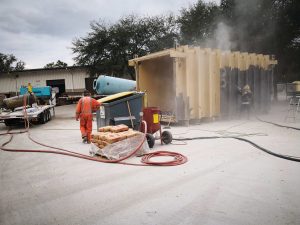
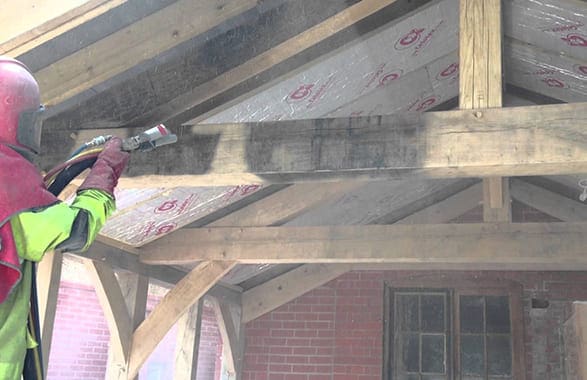
Abrasive blasting – or its close cousin, shot blasting – is the most reliable way to open that surface up evenly. It strips off the weak top layer of laitance, removes old coatings and contaminants, and leaves the consistent profile a coating needs, all in one pass. Our concrete blasting work is built around producing exactly that.
What Has to Come Off First
Bare new concrete is rare on the jobs we see. Usually there is something in the way:
- Laitance – the weak, dusty layer of fine cement that rises to the surface during finishing. Coat over it and the coating peels with the laitance still stuck to its back.
- Cure-and-seal products – sprayed on when the slab was poured, these are designed to repel moisture, which means they also repel your coating.
- Old failed coatings – the previous epoxy that did not last, which has to come off completely, not get buried.
- Oil, grease, and tire marks – common on garage and shop floors, and they have to be degreased before blasting or they just get driven deeper.
Blasting handles most of this mechanically, which is far more dependable than chemical strippers that can leave residue behind to interfere with the new coating.
The Florida Moisture Problem
Here is what makes Central Florida slabs tricky: moisture. Concrete is porous, our water table is high, and a slab without a good vapor barrier under it can wick moisture up from the ground for years. That vapor pushes up against any coating sitting on top, and if the coating is not chosen and applied with that in mind, you get bubbles, blisters, and delamination. Prep does not fix a moisture problem on its own, but proper prep is what lets us see it – a profiled, opened slab can be moisture-tested honestly, where a sealed glassy one hides the issue until your coating fails. When we prep a floor, we are also reading it, and we will flag a moisture concern before you spend money coating over it.
Why the Same Crew Should Prep and Coat
The single most common cause of coating failure is a disconnect between the people who prepped the surface and the people who coated it. When one crew does both, that gap closes. We know the profile is right because we created it. We know the slab is clean because we cleaned it. We know how long it has been open and whether the moisture reading was sound, because we were standing on it. That is the logic behind pairing our prep with our own coating and painting services – no handoff, no finger-pointing, no “the other guys must have left it dirty.”
Where Concrete Prep Comes Up Around Ocala
We profile slabs for garage floors, barn aisles and wash racks, commercial kitchens, warehouse and shop floors, and pool decks across Marion County. Horse country adds its own wrinkles – wash-rack floors that need grip when wet, feed-room floors that need a sealable, cleanable surface, and barn aisles that take abuse from hooves and equipment. Each wants a profile and a coating matched to the actual use, not a one-size spec.
If you want the technical grounding, the federal EPA renovation guidance is worth knowing for any older structure, and surface-prep standards bodies publish the profile specs coatings manufacturers reference. The short version for a property owner: insist that whoever coats your floor can tell you what profile they are creating and how they are checking it.
Get the Slab Read Before You Coat It
Before you buy a single gallon of epoxy, have the concrete looked at by someone who will tell you the truth about it. We assess the slab, identify what has to come off, check for the moisture and profile issues that doom coatings, and quote the prep and the coating as one written plan. A good coating over a properly profiled slab is one of the best maintenance dollars you can spend in this climate. The reverse is a do-over.
Need sandblasting in Ocala or anywhere in Marion County? Call 352-723-0181 for a free on-site estimate, or request a quote online.
Skip the concrete surface prep and you pay for the floor twice – profile is everything.