Sandblasting wrought iron is a detail game. Gates, stair railings, fence panels, balcony scrollwork — most of the time the metal underneath is fine. It is the hundred layers of paint and the rust blooming out of every joint that make people think the whole thing is shot. Here in Ocala and across Marion County we see a lot of ornamental iron: farm entrance gates with a horse silhouette worked into the middle, estate fencing running along the shady side of a horse farm, porch railings on the older houses near the downtown square. Blast it right and every leaf, curl, and collar in the scrollwork comes back sharp. Blast it wrong and you round those details off — or punch holes clean through them.
This is the honest version of how we handle wrought iron, including the jobs where we will tell you blasting is the wrong call.
First, Know What Your “Wrought Iron” Actually Is
Three different metals get called wrought iron, and they do not blast the same.
True wrought iron is the old stuff — hand-worked, pre-1930s, with a grain to it almost like wood. It is tough, forgiving, and a pleasure to clean. If you own a genuine piece, it is worth restoring nearly every time.
Mild steel fabrications are what most “wrought iron” gates and railings have actually been since the 1950s: steel bar and tube, bent and welded into ornamental shapes. Perfectly good material. Blasts beautifully. But the hollow-tube versions can be thin, and thin matters — more on that below.
Cast iron is poured into a mold, not worked. Victorian fence finials, ornate brackets, old urns and posts. It is brittle. It does not bend, it cracks. Cast iron gets gentler media, lower pressure, and more patience.
And then there is the modern “iron-look” aluminum gate from a big-box store. If that is what you have and the powder coat is mostly intact, blasting it back to bare metal is usually money you do not need to spend. A scuff and a repaint gets you there. We will tell you so on the estimate.
Why Sandblasting Wrought Iron Beats Grinders and Strippers
People try three things before they call us: a wire wheel on a drill, a grinder with a flap disc, and chemical stripper. Here is the honest part most people skip — none of them can reach where the rust actually lives.
Ornamental iron rusts from the tight spots outward: the collar where two scrolls are banded together, the V where a picket meets the bottom rail, the seam behind a rivet, the inside curve of a curl. A wire wheel cleans the faces you can see and burnishes right over the trouble. Chemical stripper turns forty years of paint into a hanging goo you get to scrape out of every crevice by hand, and whatever residue stays in the joints goes to work on your new paint from day one.
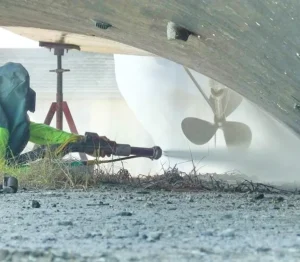
Abrasive blasting is the only method that cleans the full profile of every twist and curl, because the media goes wherever air goes — which is exactly where the rust went. It strips paint, rust, and mill scale in one pass and leaves a uniform anchor profile the primer can actually bite into. That profile is the difference between a paint job that lasts a couple of summers and one that lasts fifteen years.
6 Honest Rules for Sandblasting Wrought Iron Without Losing the Detail
1. Match the media to the metal
Coarse slag at high pressure is for a dumpster or a bridge beam, not a gate. On sound steel ornamental work we run a finer abrasive that cuts the coating without chewing the crisp edges off the detail. On delicate faces and cast pieces we go gentler still. And no — we do not use silica sand. OSHA’s abrasive blasting guidance is blunt about crystalline silica for good reason, and safer media clean better anyway. Same price whichever media the job wants. We pick by the job site, never the invoice.
2. Drop the pressure on the scrollwork
Thin scroll stock and hollow pickets will warp or blow through if you lean on them with full pressure at close range. So we do not. We throttle the pot down, stand off a little farther, and keep the nozzle moving at a low angle. It takes longer. It is the only way the detail survives. Anyone who quotes you a wrought iron job by promising speed is telling you which corner they plan to cut.
3. Expect the blast to find the rot
If a picket has rusted from the inside out, blasting will open it up. That is not damage — that hole was already there, hiding under filler and paint, and it was getting bigger every wet season. Better to find it now, while a welder can drop in a new section of matching stock, than two years after your new paint job. When the blast finds a soft spot, we stop and show you before we keep going. No surprises on the walkthrough.
4. Prime before supper
Bare iron in Florida humidity starts flash rusting within hours — in an Ocala summer, sometimes faster than that. A gate blasted white on Tuesday and primed on Thursday is a gate you paid to clean twice. Our crew blasts and primes the same day, every crevice sealed before the evening damp settles in. One crew, one day, no finger-pointing between a blasting company and a painting company, because we are both. That is the whole point of our painting and coating service riding on the same truck as the blast pot.
5. Coat every crevice, not just the faces
The same tight joints that trapped rust will trap it again if the primer only lands on the show surfaces. We work primer into the collars, seams, and picket joints — brush and detail work where the spray gun cannot reach properly. A zinc-rich or rust-inhibitive primer under a quality topcoat is what keeps a restored gate restored.
6. Know when not to blast
If you have one railing section with a little surface rust, a wire brush, a rust-converting primer, and a Saturday will do — and we will tell you exactly that on the phone. If the gate is thin-wall imported tube already rusted through in a dozen places, restoration can cost more than a better-made replacement, and we will tell you that too. We would rather lose a small job than have you unhappy about a big one.
What This Looks Like on a Marion County Job
Horse country is hard on ornamental iron. Farm entrance gates take sprinkler overspray on a timer, fertilizer dust, and hot wet air roughly forever — the bottom rail and the lower scrolls always go first. Board-fence country roads throw mud in spring. And the ornate work is usually the first thing a visitor sees at the end of the drive, which is exactly why owners want it kept, not replaced.
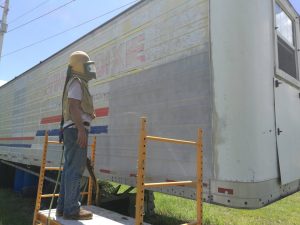
Our rig is fully mobile. We set up at the farm, drape containment where it is needed, and blast gates in place or pull panels flat depending on what the piece wants — same approach as the rest of our metal sandblasting work in Ocala. For iron mounted close to a house, pool cage, or landscaping you would rather not sweep abrasive out of, dustless blasting keeps the mess down, though we will be straight with you about its trade-offs on ornate detail — wet blasting tight scrollwork means rinse water and slurry in every crevice, and it all has to be blown clean and dried before primer. A lot of the time, honestly, dry blasting with proper containment is the better choice for ornamental iron.
When We Will Tell You Not to Hire Us
A quick recap, because this is the part competitors leave out. We will talk you out of blasting when the piece is decent powder-coated aluminum that just needs a scuff and repaint. When the rot is past what a welder can reasonably rebuild. When the honest fix is a wire brush and an hour of your own time. The gate business runs on trust the same way the horse business does — the honest no is what earns the next yes.
If your iron does deserve blasting, you will get the detail back, primer on the same day, and one number on a written quote — the number you approve is the number on the invoice.
Need sandblasting in Ocala or nearby? Call (352) 723-0181 for a free on-site estimate. You will reach someone who actually does the work.