If you are putting a new coating on a pool deck in Ocala, the coating is not the part that decides whether you are still happy in three years. Pool deck coating prep is. I have walked up on more failed pool decks in Marion County than I can count, and almost none of them failed because somebody bought cheap material. They failed because the slab underneath was never opened up, never dried out, or never cleaned of whatever was already sitting on it.
Here is the honest part most people skip: a pool deck is one of the meanest slabs in Florida to coat. Full sun. Chlorine or salt splash. Wet ground under it. Bare feet on top of it. Get the prep wrong and the coating will tell on you inside of one summer.
Why Pool Deck Coating Prep Fails More Often Than the Coating Does
Coating manufacturers are not shy about this. Read the back of almost any deck coating bucket and you will find a paragraph about surface preparation that is longer than the mixing instructions. That is not legal cover. That is the manufacturer telling you where the job gets won or lost.
A coating does not stick to concrete because it is sticky. It sticks because it grabs into thousands of tiny anchors in the surface and because there is nothing between it and the slab. Old sealer, curing compound, chlorine residue, sunscreen, pool chemicals, efflorescence, a slick troweled finish — any one of those is a layer of "nothing to grab." Every dollar and hour of pool deck coating prep goes into removing that layer and building the anchors back.
1. Find Out What Is Already on the Slab
Half the pool decks around Ocala have been coated before. Cool-deck texture, acrylic lace, a knockdown overlay, three generations of deck paint, or a solvent sealer somebody rolled on in 2009. You cannot coat over most of that and expect it to hold, because your new coating is only as strong as the weakest layer under it.
Two field tests take five minutes. Pour a little water on the slab in a few spots. If it beads and sits, there is a sealer or a coating in the way. Then score a small X with a razor and pull a strip of duct tape off it hard. If the old layer lifts, it will lift under your new coating too — just later, and in bigger sheets. When either test fails, the old material comes off. All of it, not the loose parts.
2. The Slab Is Drinking From Underneath
This is the one that catches Florida homeowners. A pool deck sits on damp ground, next to a body of water, in a county where the water table can come up after a good week of afternoon storms. Moisture moves up through the slab as vapor, hits the back of your new coating, and pushes. That is what those dime-sized bubbles and white blush patches are. It is not bad paint. It is vapor drive.
Before anything gets coated, the slab needs a moisture check — a calcium chloride test or an in-slab relative humidity probe, depending on the coating you have picked. Then compare the number to what the coating actually allows. Some products tolerate a wet slab. Most do not. If the slab reads high, you either wait it out, change the coating, or put down a moisture-tolerant primer. What you do not do is coat it anyway and hope. Hoping is not a system.
3. Profile Is the Whole Job
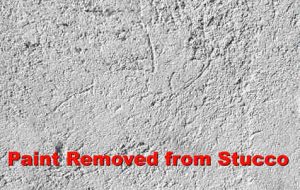
Concrete surface profile is the roughness the coating grabs into. The industry puts numbers on it — CSP 1 is close to a light etch, CSP 3 feels like medium sandpaper, and it gets more aggressive from there. Thin sealers want a light profile. Thicker broadcast systems and epoxies want more tooth. The coating data sheet will name a number. That number is not a suggestion.
Acid etching gets recommended a lot on the internet, and I will say it plainly: on an Ocala pool deck it is usually the wrong call. It is inconsistent, it leaves salts behind that have to be neutralized and rinsed, and the rinse water has to go somewhere — usually into the pool or the flower bed. Abrasive blasting gives a uniform profile in one pass with no chemistry to neutralize afterward. The SSPC surface preparation standards for concrete cover this ground, and we follow them the same way we would on a steel job. If you want the deeper version, we wrote it up in our guide to concrete sandblasting in Ocala.
4. Fix the Cracks and Spalls Before, Not After
A coating is roughly the thickness of a business card. It will not bridge a crack, hide a spall, or level a low spot where water stands after a storm. Whatever the slab does structurally, the coating does too — it just does it in color.
The right order is blast first, look second, patch third, coat fourth. Blasting strips the deck down so you can finally see what you have: hairline shrinkage cracks that do not matter, moving cracks that need a real joint treatment, spalls where a rebar chair sat too close to the surface, and the low corner nobody noticed under the old texture. Patch materials also bond dramatically better to a freshly profiled slab than to a sealed one. Patching first and blasting after just means blasting your patches back off.
5. Match the Method to the Deck
Not every pool deck wants the same approach, and any outfit that runs one method on every job is picking by their equipment, not by your slab.
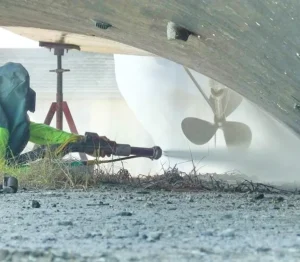
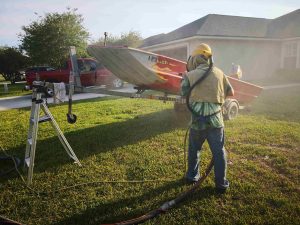
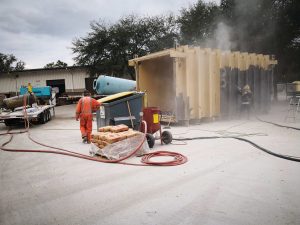
Open decks with heavy old coating take dry abrasive blasting well — it is fast and it profiles as it strips. Decks inside a screen enclosure, or tight against tile, coping, and a full pool, are a different animal, and that is often where dustless blasting in Ocala earns its keep, because the water knocks the dust down instead of coating the lanai and the pool surface with it. The trade-off is real and I will say it out loud: dustless leaves a wet, muddy deck that has to be rinsed and dried before anybody coats anything, and it adds a day. Grinding has its place too, mostly on small decks and slick troweled finishes.
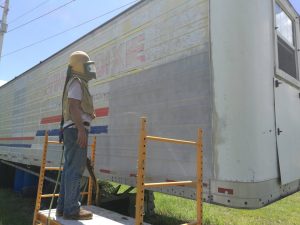
Whichever method, silica dust is not something to shrug at. OSHA's abrasive blasting guidance covers respiratory protection and containment, and it is the reason a DIY rental blaster on a Saturday is a worse idea than it looks. Containment also matters for your neighbors and for the pool itself — the pool gets covered, the equipment gets shut down and sealed, and the coping and tile get masked before the first trigger pull.
6. Coat It Clean and Coat It Soon
After blasting, the deck is full of spent media and concrete dust sitting down in the profile you just built. That dust is a bond breaker. Vacuum it — a proper HEPA vac, not a leaf blower that just moves the problem to the other end of the deck and drops it back down an hour later.
Then coat within the window the manufacturer gives you. A freshly profiled slab is wide open, and in Ocala humidity it will pull moisture and pick up dirt, pollen, and pool splash fast. On our jobs the goal is simple: blast it, vac it, prime it the same day when the moisture numbers and the weather cooperate. We handle the coating and painting side in Ocala ourselves, which is mostly why we can hit that window — there is no second contractor to schedule around.
When We'll Tell You Not to Coat It at All
Some pool decks should not get a coating. If the slab is heaving, if there is a moving crack running the length of it, or if the moisture numbers are sky high and there is a drainage problem nobody has fixed, a coating is money spent on a symptom. Fix the drainage or replace the slab section first. We will tell you that on the estimate rather than after.
Same goes the other direction. If your deck is sound bare concrete with a decent profile already and no old coating on it, you may not need us at all — a good wash, the right primer, and a careful weekend can get you there. If a wire brush and a Saturday will do, we will say so. The honest no is worth more to us than the job.
How We Run Pool Deck Coating Prep in Ocala
Our order rarely changes. We look at the deck in person, run the water and tape tests, and check moisture. We mask the pool, the coping, the tile, the screen frame, and anything else that is not getting coated. We pick the media and the method by what is on the slab and how tight the space is — same price either way, we choose by the job site, never by the invoice. We blast to the profile the coating calls for, walk it with you, patch what needs patching, vacuum it down, and prime.
From Ocala proper out to Belleview, Silver Springs, Dunnellon, and the farms up the 27 corridor, most of the pool decks we prep are 20 to 40 years old and have been coated at least once. That is normal. It just means the prep is the job, and the coating is the easy part at the end.
Need sandblasting in Ocala or nearby? Call (352) 723-0181 for a free on-site estimate. You will reach someone who actually does the work.