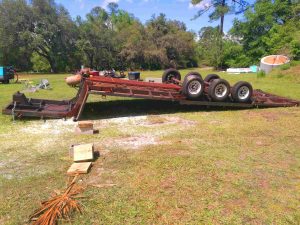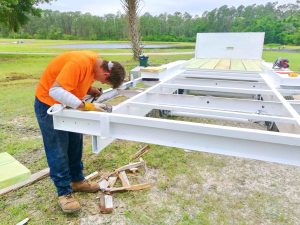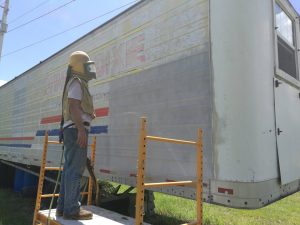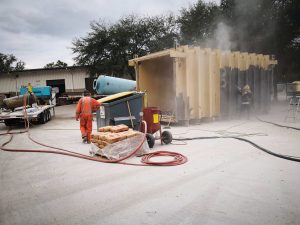
Marine surface preparation is the part of a dock, seawall or waterfront steel job that decides whether the coating lasts five years or five months. Around Ocala that usually means a steel dock frame on a Marion County lake, a bulkhead cap on a pond, a pump house by the water, a boat lift, or a pipe rail that gets wet every morning from the dew and every afternoon from the thunderstorm. Fresh water is gentler than salt, but Florida humidity does not care. Steel near water rusts on a schedule.

Here is the honest part most people skip: the paint is almost never what fails. The prep is. A good coating over a bad surface peels. A decent coating over a clean, profiled surface hangs on for years. So this post is about the surface, not the paint can.
Marine Surface Preparation Starts With Knowing What You Own
Before anyone talks about blasting, figure out what the waterfront piece actually is. Is it structural steel, like a dock frame or a lift cradle? Is it thin sheet or tube, like a handrail or a ladder? Is it concrete, like a seawall cap or a boat ramp edge? Each one wants something different.
Thick structural steel is the easy yes. It has the mass to take a proper blast without moving. Thin tube and sheet needs gentler media and a lighter hand, because aggressive blasting can warp it or thin it out. Concrete needs its own approach entirely, and we handle that on our concrete sandblasting side of the shop.
Tap the steel with a hammer. Solid metal rings. Rotten metal thuds. If a screwdriver pokes through, that section needs a patch or a replacement, not a new coat of paint. We will tell you that straight, even if it means no job for us.
Rule 1: Get the Salt and Grime Off Before You Blast
Even in fresh water country, waterfront steel carries more than rust. It carries algae, mud, bird droppings, boat fuel residue and a film of minerals that dries on every time the water level drops. Blasting over that drives contamination into the surface.
Wash it first with clean water. Let it dry. Then blast. If you are near brackish water or a coastal trip left salt on the piece, the washing matters even more. Soluble salts trapped under paint pull moisture through the coating and blister it from underneath. That is one of the standard failure modes you read about in SSPC surface prep guidance, and it is why the cleaning step is not optional.
Rule 2: Pick the Cleanliness Level Before You Pick the Coating
Blasted steel is graded by how clean it ends up. The shorthand most coating makers use comes from SSPC and NACE standards: a brush-off is light, a commercial blast is mostly clean, a near-white blast is very clean, and a white metal blast is every speck gone. Higher is not always better. It is more time and more media.
For most waterfront steel, a near-white level is where the real protection starts. Your coating data sheet will tell you what the manufacturer requires. If the sheet says near-white and the prep stops at commercial, the warranty and the paint both walk away. Ask for the spec before the job starts, and have it in writing.
Rule 3: Profile Matters As Much As Clean
Profile is the microscopic roughness the blast leaves behind. Coatings grip that roughness like Velcro. Too smooth and the paint slides. Too rough and thin spots on the peaks rust through first.
Different media leave different profiles. Garnet and coal slag cut a deeper anchor pattern than glass bead, which leaves a satin finish. We match the media to the steel and the coating, not to what is already in the truck. If you want the full rundown, our post on abrasive types compared covers it.
Rule 4: Same-Day Priming Is Not a Suggestion
Bare steel near water rusts fast. In Marion County humidity, a freshly blasted dock frame can show flash rust within hours, sometimes before lunch if the morning is damp. We wrote a whole piece on that in flash rust and bare steel, and it applies double on the waterfront.
The fix is boring and it works. Blast in the morning, prime before the surface turns, and have the coating system ready to go. If a crew blasts a dock on Monday and primes it on Thursday, you paid for the blasting twice.
Rule 5: Respect the Water and the Wind
Waterfront blasting is not the same as blasting in a parking lot. Media, dust and old paint chips cannot go into the water. That is a rule of common sense and of good practice, and it is why containment is part of the plan before the rig is unloaded.
For jobs close to a pond, lake or canal edge, dustless blasting can make a lot of sense because the water-managed process keeps dust down. It also trades one problem for another: you get slurry to catch and dispose of properly. We will tell you straight which way your job leans. Either way, tarps, catch zones and a clean-up pass are part of the work, not an add-on.
Old paint matters too. If a dock or lift was painted decades ago, there is a real chance it carries lead. The OSHA abrasive blasting guidance is the starting point for crew protection, and the EPA lead rules apply to older painted surfaces. Test before you blast. We covered it in our post on lead paint safety on older Florida buildings.
Rule 6: Choose a Coating System, Not a Can
The single can of paint from the hardware store is not a marine coating system. A real system has layers: a primer that bonds to the blasted steel, an intermediate coat that builds thickness, and a topcoat that takes sun and water. Each layer has a window for how long you can wait before the next one goes on.
Our painting services side handles coating after blasting, which means the same crew that cleaned the steel is the crew that primes it. That is the whole point. No handoff, no gap, no finger-pointing about whose fault the peeling is. We covered the long-game version in rust prevention coatings that beat Ocala humidity.
Rule 7: Know What We Do and What We Do Not
We are a mobile crew. The rig comes to you, and we work on dry, accessible steel and concrete. If the piece is underwater or needs a diver, that is not us, and we will say so up front. If you can walk up to it, reach it, or pull it out of the water and set it on blocks, we can usually work with it.
We also tell people when blasting is the wrong answer. A rail with light surface rust and a coating that is mostly sound might need a wire brush and a Saturday afternoon. A dock frame with half the wall thickness gone needs a welder, not a blaster. Honest advice beats a wasted job.
A Quick Checklist Before You Call
You do not need a spec sheet to get started. A few details help us give you a straight answer on the phone:
- What the piece is made of and roughly how thick it is.
- Whether it can come out of the water or has to be worked in place.
- How old the existing paint is, since pre-1978 coatings raise the lead question.
- Whether you have a coating already picked or want help matching one to the steel.
- A few photos in good daylight, including close-ups of the worst spots.
With that, we can usually tell you in one call whether it is a blast job, a brush job or a replace job. The written estimate after the site visit is the number that counts.
Marine Surface Preparation: The Short Version
Wash it. Pick the cleanliness level the coating requires. Get a profile the paint can grip. Prime before the steel turns. Keep the debris out of the water. Use a real coating system. And hire the crew that will tell you when not to blast. Do those and a waterfront steel job around Ocala holds up through the humidity, the storms and the summer sun.
You can also browse more of our work on the metal sandblasting in Ocala page, or check how long a sandblasting job takes before you plan around a weekend.
Ocala Sandblasting | (352) 723-0181 | https://ocalasandblasting.com/
Need sandblasting in Ocala or nearby? Call (352) 723-0181 for a free on-site estimate. You will reach someone who actually does the work.