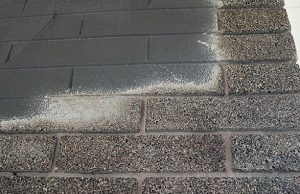
Sandblasting brick fireplace surrounds sounds simple until you picture it happening in your living room. Somebody painted the brick white in 1998, you hate it, and now you want the old red back. Fair. We get that call around Ocala all the time, from ranch-style homes off the Silver Springs side to farmhouses out in Marion County horse country. The honest answer is that it can be done, it can also go badly, and the difference is almost entirely in how the job is planned.

Here is the honest part most people skip: an indoor brick job is a containment job first and a blasting job second. The blasting is the easy half. Keeping dust, water and old paint out of your couch, your vents and your lungs is the hard half. So this post walks through the six rules we follow before we ever aim a nozzle at a fireplace.
Rule 1: Know What Is on the Brick Before Anything Else
Painted brick in an older Ocala house can carry layers. Latex on top, oil-based underneath, maybe a masonry sealer under that. Anything painted before 1978 can have lead in it, and a fireplace wall in an older home is a classic place for it. Blasting turns lead paint into fine dust, and fine dust in a closed house is exactly what you do not want.
Test first. A cheap swab kit from the hardware store gives you a starting answer, and a certified lead inspector gives you the real one. The EPA’s Renovation, Repair and Painting program lays out the rules for work that disturbs lead paint, and we wrote our own plain-English take in lead paint safety on older Florida buildings. If the test comes back positive, the job changes. Sometimes it changes into “do not blast this indoors,” and we will say so.
Rule 2: Pick the Right Method for Sandblasting Brick Fireplace Walls Indoors
This is where most fireplace jobs go sideways. Dry blasting with hard media is fast and it is also dusty and aggressive. Brick is not steel. Old Florida brick is often soft, low-fired and porous, and a hard abrasive at the wrong pressure will eat the face right off it. You end up with a pitted, fuzzy wall instead of a clean one.
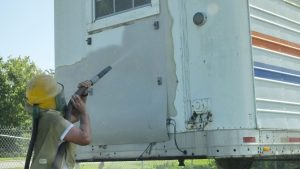
For interior masonry we lean toward gentler options. Dustless blasting keeps the airborne dust way down because the abrasive travels in a water stream. Soda blasting is softer still and can strip paint off delicate surfaces without scarring them. Neither is magic. Dustless blasting trades dust for a wet slurry you have to catch and haul out. Soda leaves residue that has to be rinsed off. We will tell you straight which one your wall wants once we have seen it, and we pick by the brick, never by what is easier for us.
Our standard brick sandblasting page covers the exterior side of this work. Inside the house, everything gets slower and more careful.
Rule 3: Containment Is Not Optional
If a quote for an indoor fireplace job does not mention containment, keep shopping. Real containment means plastic sheeting sealed floor to ceiling with tape, floor protection that runs well past the work area, the HVAC returns and supply vents blocked off, and a plan for where the debris goes. A fireplace wall in a great room is usually open to the rest of the house, so the barrier has to be built, not hung.
Florida adds its own twist. Our humidity means a wet process leaves moisture hanging in the air and in the porous brick for days. Running dehumidifiers during and after the job keeps a clean wall from sprouting mildew in July. Skip that step and you swap one problem for another.
Also be honest with yourself about furniture. Move it out of the room. “Covered in plastic” is not the same as “safe.” Fine dust finds a way.
Rule 4: Protect the Firebox and the Mortar
Two parts of a fireplace need special respect. The first is the firebox, the inner chamber where the fires actually burn. Firebrick and the thin refractory mortar between the bricks are built for heat, not for impact. Blasting them hard can open joints that you then have to repair before you can safely light a fire again. In most cases we recommend leaving the inside of the firebox alone and focusing on the face, surround and chimney breast.
The second is the mortar everywhere else. Old mortar is softer than the brick around it, which is exactly how it is supposed to behave. Blast it with the wrong media or too close and it washes out of the joints. Deep, hollowed-out joints mean repointing, and repointing is a separate job with a separate bill. Good technique is the difference between a clean wall and a wall that needs rebuilding.
One more point that has nothing to do with blasting. If the chimney has not been inspected in years, get that done by a certified chimney professional before or after the cosmetic work. Pretty brick over a cracked flue liner is still a fire risk. We do surface prep, not chimney safety inspections, and we are not going to pretend otherwise.
Rule 5: Decide Whether Blasting Is Even the Right Call
Sometimes it isn’t. If the paint is a single thin coat and the wall is small, a good chemical stripper and a stiff brush can win, and that is a Saturday project you can do yourself. If the brick is crumbling, spalling or heavily damaged, stripping the paint will only show you how bad it is underneath. And if you actually like the painted look but just want a fresher color, a new coat is cheaper in effort than removal ever will be.
Blasting earns its place when there are multiple layers, when the brick is textured and the paint is stuck in every pore, or when a chemical stripper has already failed you. If you want to keep the paint and just change it, our painting services in Ocala exist for exactly that. If a wire brush and a Saturday will do, we will tell you.
Rule 6: Plan the Finish Before You Strip
Raw brick that has just been stripped is thirsty. It soaks up everything: spilled drinks, soot, humidity. Decide ahead of time what the finished wall will look like. Natural brick with a breathable masonry sealer keeps the look and keeps stains out. A fresh coat of paint is a fine choice too, as long as it goes on after the brick has dried completely. Painting over damp masonry is how you get bubbling six months later.
Give the wall time. In our humidity that can mean several days of drying before any sealer or paint goes on. A rushed finish is the number one reason a good strip job looks bad a year later. We would rather tell you to wait than watch you repaint.
What a Fireplace Job Looks Like With Us
We walk the room first. We look at the brick, test a small hidden spot, check what the paint is, and look at how the room connects to the rest of the house. Then we tell you the method, the containment plan and the realistic timeline, in writing. Our crew handles the blasting and can handle the finish as well, same people, same day when conditions allow. If the test spot shows the brick is too soft or the paint is lead and the room cannot be sealed properly, we will say no. A refused job is better than a ruined fireplace.
Curious how long it takes? Plan on a few days for an indoor job once you count setup, containment, drying and cleanup, not a few hours. Outdoor chimneys and fire pits go much faster, and those are jobs we handle all over Marion County.
Final Word on Sandblasting Brick Fireplace Walls
It can look fantastic. Old brick under a coat of white paint is often beautiful, and getting it back is satisfying. But the rules are simple. Test for lead. Match the method to soft Florida brick. Build real containment. Protect the firebox and the mortar. Be honest about whether blasting is the right tool. Plan the finish before you start. Do those six things and your fireplace becomes the best wall in the house. Skip them and you pay twice.
For more on what the OSHA side of abrasive work involves, see the OSHA abrasive blasting overview.
Ocala Sandblasting | (352) 723-0181 | https://ocalasandblasting.com/
Need sandblasting in Ocala or nearby? Call (352) 723-0181 for a free on-site estimate. You will reach someone who actually does the work.