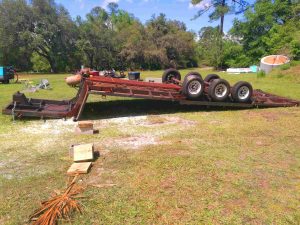

Trailer frame restoration is the job most people put off until something falls off. A fender bracket cracks. You kick a crossmember and it flakes. The deck boards come up and the steel underneath looks like burnt pastry. Around Ocala we see it every week, on boat trailers that live half their life backed into Lake Weir and on utility trailers that haul hay five days a week and sit under an oak the rest of the time. The frame is the part nobody looks at until it is the only part that matters.

Here is the honest part most people skip: blasting a trailer frame is the easy half. The hard half is everything you have to take off it first, and the decision about whether the steel is worth saving at all. We would rather tell you that up front than take your deposit and hand you a pretty frame with a tired axle under it.
Trailer Frame Restoration Starts With Stripping the Trailer, Not the Paint
A trailer that rolls in loaded is a trailer that gets blasted badly. Media goes where air goes, and air goes into every bearing, every wiring loom, every threaded fitting. So the first real step is disassembly.
Deck boards come off. Fenders come off if they are bolted. Lights, wiring harness and the junction box come out entirely – not taped over, out. Tape does not survive a blast nozzle and you will end up chasing a ground fault six months later wondering why the left turn signal is moody. Hubs get pulled or bagged and sealed. Leaf springs and shackles usually stay, because they blast clean and they need it worse than the rest of the frame. The coupler gets masked at the ball socket.
If the trailer has a winch, a jack, or a brake actuator, those come off too. Grit in an actuator is an expensive lesson. This is the stage where an honest shop earns its money, and it is also the stage a customer can do themselves over a weekend if they want to save the labor. We will tell you straight which parts are worth you pulling and which ones you should leave to us.
What Marion County Does to a Trailer Frame
Central Florida is hard on trailers in three specific ways, and knowing which one hit yours tells us how to blast it.
First, humidity. Bare or thin-painted steel here does not wait. It flash rusts before supper. That is not a figure of speech – we have watched a clean frame haze over in under four hours on an August afternoon in Ocala.
Second, water immersion. Boat trailers at the Ocklawaha and Lake Weir ramps get dunked, then driven home wet, then parked. Water sits inside the tubing where nobody can see it. The frame rots from the inside out and looks fine from the outside until the day it does not.
Third, manure and feed. Horse country is rough on steel in a way people underestimate. Ammonia and wet bedding sitting on a stock trailer floor will eat a crossmember faster than rain ever will. If you haul around Marion County, look at the frame directly under the tailgate area first. That is where it goes.
Galvanized Is Not the Same Job as Painted Steel
A lot of boat trailers in this county are galvanized, and galvanized changes the conversation. Zinc coating is sacrificial – it is there to corrode instead of the steel. Blast it off aggressively and you have removed the exact thing protecting the frame, then you own the problem of replacing that protection with paint.
So we ask first: is the galvanizing mostly intact with surface staining, or is it gone and the steel underneath scaling? If it is mostly intact, honestly, the best move is often not a full blast at all. Clean it, spot-treat the bad areas, leave the good zinc alone. If the zinc is spent and the frame is scaling, then yes, strip it and build a real coating system on top – but understand you are switching protection strategies, not just changing colors.
Painted steel frames are simpler. Blast to bare metal, get a proper anchor profile, prime. Our metal sandblasting in Ocala work is mostly this – steel that needs the old system gone completely so the new one has something to bite.
Blasting Inside the Tubing: The Honest Answer
People ask if we can blast the inside of a box-tube frame. Mostly, no. A nozzle cannot see around corners, and the inside of a two-by-four tube twelve feet long is not reachable in any way worth what it would cost. Anyone who tells you they blasted the inside of your frame clean is telling you a story.
What we can do is honest and useful: open or clear the drain holes, get the inside dried out, and flood the cavity with a proper cavity wax or internal frame coating after the outside is done. That is what the trailer manufacturers do and it is what actually extends the life of the tube. It trades one problem for another – the wax attracts dust and looks unlovely – but it beats rot.
If the tube is already perforated from the inside, no coating fixes that. That frame needs a welder before it needs a blaster.
When We Tell You Not to Restore the Frame
Some trailers should not be restored, and we will say so. If the main rails are pitted deep enough that you can catch a fingernail in the craters across a wide area, blasting will only reveal how thin they are. If a crossmember rings dull instead of sharp when you tap it, it is rotten through. If the tongue has been welded and re-welded by three different people, the money belongs in a different trailer.
A light utility trailer with a rotten frame is usually not worth the full process. A gooseneck stock trailer or a thirty-foot equipment trailer almost always is, because the replacement cost is in a different universe. That is the honest calculation, and we would rather make it with you in your driveway than after the fact.
Primer Goes On the Same Day – Every Time
This is the rule we do not bend. Bare steel in Marion County starts oxidizing immediately, and a haze of flash rust under a topcoat is a coating failure with a delay fuse on it. We blast and prime the same day, same crew, same visit. If weather is going to stop us from priming, we do not start blasting.
For most trailer frame restoration work that means a blast profile matched to the primer, a direct-to-metal epoxy or zinc-rich primer while the steel is still bright, then the topcoat once the primer has flashed. Our painting and coating services in Ocala exist for exactly this reason – blasting and coating by two different companies on two different days is how frames end up rusting under fresh paint.
Where containment matters – a driveway, a barn aisle, a shop with equipment nearby – dustless and green blasting in Ocala keeps the mess down. It is not free of trade-offs. Wet blasting leaves a slurry you have to manage and it introduces water to steel you are trying to keep dry, so we match the method to the job site, never to the invoice.
Blasting is genuinely hazardous work, too. Respiratory protection, containment and media handling are regulated for good reason – OSHA covers abrasive blasting safety here if you are thinking about doing it yourself. And if a wire wheel and a Saturday will handle your fender brackets, we will tell you that as well.
The 7 Steps of a Trailer Frame Restoration, Start to Finish
- Assess before anything else. Tap-test the crossmembers, check the tongue welds, look under the deck. Decide whether the frame is worth the work.
- Disassemble. Deck, lights, wiring, hubs, actuator, winch. Off, not taped.
- Degrease. Axle grease and road film do not blast off – they smear. The frame gets cleaned before media touches it.
- Blast to profile. Media matched to the steel and to the coating that follows, with real attention to the underside where the rot actually lives.
- Inspect bare metal. This is when hidden pitting and perforation show themselves. If it needs a welder, it gets one now, not after paint.
- Prime the same day. No overnight bare steel. Ever.
- Topcoat, cavity wax, reassemble. New wiring, sealed connections, deck back on.
Done properly, a blasted and coated frame in this climate should give you many good years before it needs more than a touch-up. Done in a hurry over rusty steel, it will look excellent for one season and embarrassing by the next. There is no middle version of this job.
Need sandblasting in Ocala or nearby? Call (352) 723-0181 for a free on-site estimate. You will reach someone who actually does the work.