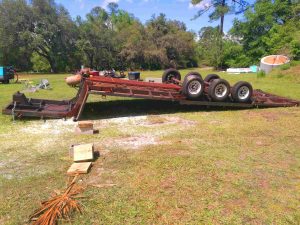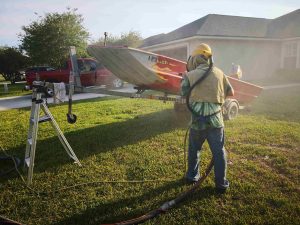
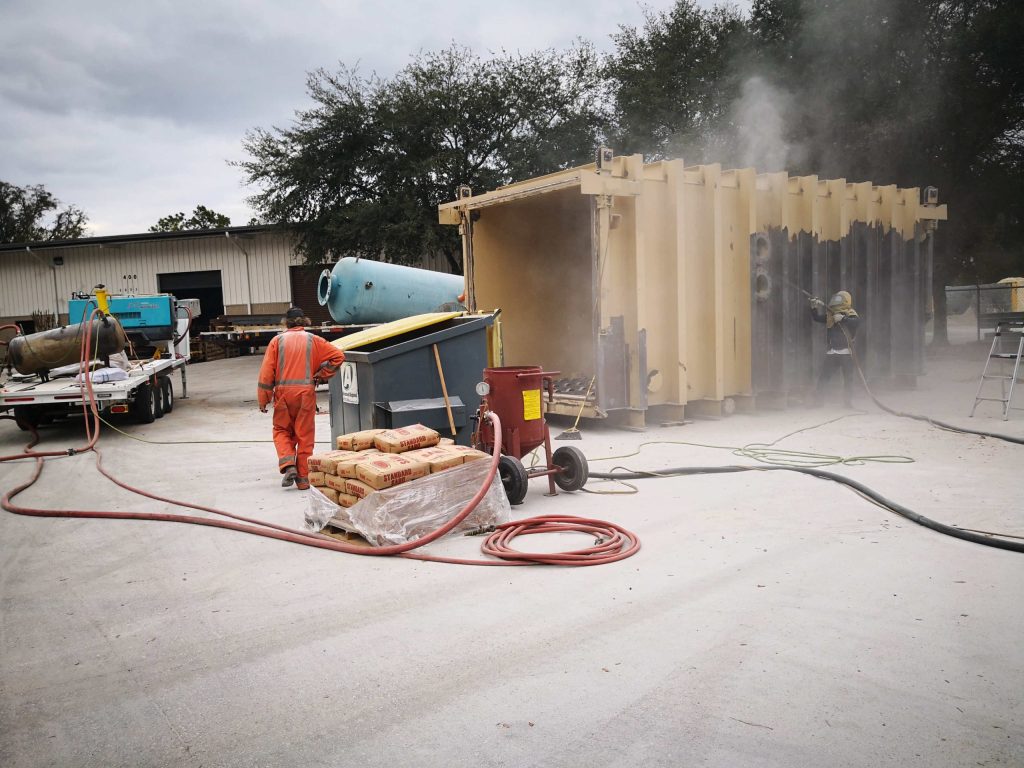
Rust prevention coatings are the whole reason we bother blasting in the first place. Stripping a gate, a stock trailer or a bush hog down to bare steel feels like the big job, and it looks like the big job, but blasting is only the setup. The coating is the part that has to survive ten Ocala summers. Get the coating wrong and you have paid for a very expensive way to make clean metal rust faster than it did before.
Here is the honest part most people skip: in Marion County, the coating fails more often than the steel does. We see it every month. Somebody blasted a trailer frame, let it sit overnight because a storm rolled in, then sprayed a hardware-store rattle can over the haze the next morning. Eighteen months later it is peeling in sheets and the customer thinks the metal was bad. The metal was fine. The system was wrong.

1. Rust prevention coatings only work on steel that was prepped right
No coating on earth sticks to mill scale, old chalked enamel or soluble salts. That is not a marketing opinion, it is the reason SSPC surface preparation standards exist at all — the cleanliness grade you blast to is written into the coating manufacturer’s warranty. Most industrial primers want an SSPC-SP 6 commercial blast or better, with a measured anchor profile, usually somewhere around 1.5 to 3 mils depending on the product.
Profile is the part homeowners never hear about. Blasting does not just clean steel, it roughens it. That roughness is the tooth the primer grabs. Blast too soft with worn media and you get clean steel with nothing to hold onto. Blast too aggressive and the peaks poke through a thin film and rust right at the high points. We match media to the surface on every job for that reason, and we tell you which one we picked and why.
2. The clock matters more than the brand
Bare steel in Ocala starts flash rusting in a couple of hours on a humid afternoon. Sometimes less near a wash rack or a barn aisle where the air never dries out. Once that orange film forms, you are painting over rust — a thin layer of it, but rust all the same, and it will lift your coating from underneath.
So the single most useful thing you can do for rust prevention is compress the gap between blasting and priming. Same day. Ideally same hour. That is a big part of why we blast and coat with one crew instead of blasting and handing you off to a painter who shows up Thursday. There is nobody to point fingers at when it is the same truck and the same people, and nothing sits bare overnight waiting on somebody else’s schedule.
3. Know what the three coats actually do
A real coating system has jobs, not just colors.
- Primer — adhesion and corrosion control. This is the layer doing the rust prevention. Inorganic or organic zinc-rich primers are the heavy hitters on structural steel; an epoxy primer covers most trailer, gate and equipment work.
- Intermediate or build coat — film thickness. Corrosion protection is largely a thickness game. A skinny film fails early no matter how good the product is.
- Topcoat — UV, chemicals and looks. Polyurethane and polysiloxane topcoats hold gloss and color in Florida sun. Epoxy alone chalks badly outdoors; it is a fine primer and a poor final coat in direct sunlight.
Skipping the middle of that sandwich is the most common shortcut we get asked about, and it is the one that costs the most later.
4. Zinc-rich primer earns its money on equipment that lives outside
If a piece of steel sits in weather year-round — a gooseneck frame, a hay elevator, gate hardware, a catch pen — zinc-rich primer is worth the extra cost. Zinc protects sacrificially, meaning it corrodes instead of the steel underneath even where the film gets scratched. On a trailer frame that gets nicked by gravel on County Road 225 every week, that matters more than any topcoat.
Where zinc is not worth it: interior steel, decorative pieces under a roof, anything you plan to repaint every few years anyway. We will tell you straight when a good epoxy primer is plenty and the zinc is money you do not need to spend.
5. Humidity, dew point and the rule nobody follows
Coatings have application windows, and Central Florida ignores them cheerfully. The general rule is steel temperature at least 5°F above the dew point and rising, with relative humidity under about 85%. On an August morning in Ocala, that window can be a two-hour slot before noon and gone by two o’clock when the thunderheads build.
This is the honest reason some jobs get scheduled oddly early, or get pushed a day. Spraying into a closing dew-point window is how you get a coating that looks perfect on Friday and blisters by the following spring. Moisture trapped under the film has to go somewhere. It goes sideways, and takes your adhesion with it.
6. Farm and horse-country steel has its own enemies
Marion County adds problems that a coating data sheet never mentions. Ammonia and urine in barn aisles attack coatings on stall fronts and gate hardware. Fertilizer and lime dust are corrosive. Pressure washing a trailer with harsh detergent every show weekend strips wax and slowly abrades film. Trailers that haul to the coast pick up salt that then sits in frame boxes and crevices for months.
For that work we lean toward a tougher chemically-resistant system and we pay attention to the places water hides — the back of channel, weld seams, the inside lip of a fender, the underside of a deck. Rust almost never starts on the flat face you can see. It starts in the spot nobody could reach with a wand. That is also why we do a lot of metal sandblasting in Ocala on-site rather than making you haul equipment anywhere.
7. Maintenance beats recoating, by a wide margin
The cheapest rust prevention coatings are the ones already on your equipment, kept up. Rinse salt and fertilizer off. Touch up gravel chips in the first season instead of the third. Look at frame corners and the underside of fenders once a year. A quart of touch-up and twenty minutes beats a full strip-and-recoat by a distance that will surprise you.
And here is where we talk ourselves out of work: if your equipment has sound, well-adhered paint with a few isolated rust spots, you may not need blasting at all. Spot-prep those areas, prime and touch up. If a wire wheel and a Saturday will do it, we will tell you. Blasting is for coatings that have failed broadly, for heavy scale, or for anything where you need a warranty-grade result.
What about galvanizing, powder coating and the other options?
People ask, so here is the straight answer on the alternatives, with the caveat that these are informational — hot-dip galvanizing and powder coating are shop processes, not something a mobile rig does in your barn aisle.
Hot-dip galvanizing is excellent corrosion protection and it is why new gate frames and fence posts last as long as they do. The catch is that it happens in a kettle at a plant, the part has to fit, and you cannot galvanize an assembled trailer or an installed railing. Powder coating gives a hard, attractive finish and is common on small parts and wheels, but it still depends entirely on the blast prep underneath it, and once it chips it does not self-protect the way zinc-rich primer does. Water gets under the chip and travels.
Cold galvanizing compound in a can is a real product and useful for touching up welds and scratches on galvanized steel. It is not a substitute for a primer system on a whole trailer, no matter what the label implies. Liquid wax and oil-type undercoatings have their place inside frame boxes where you cannot get a proper coating, but they need reapplying and they are not a finish.
For most Ocala equipment that lives outside and gets used, a blasted-and-primed liquid system that we can apply on site and repair on site is the practical winner. Not the fanciest answer. The one that keeps working.
What we actually do on a coating job
We look at the steel, decide the media, blast to the right cleanliness and profile, get the surface clean of dust, and prime it the same day — usually within the hour. Then build coat and topcoat per the product, in the right window, with the right film thickness. If a job needs paint only, we handle that too through our Ocala painting services, and if the substrate is masonry or concrete rather than steel, concrete sandblasting in Ocala is a different prep conversation entirely.
Abrasive blasting is also genuinely hazardous work — respiratory protection, containment and media handling all matter. The OSHA abrasive blasting guidance is worth a read before anyone talks themselves into renting a pot for the weekend.
No hype, no miracle product. Clean steel, the right primer, the right thickness, applied before Florida air gets a vote. That is the entire secret to rust prevention coatings that last.
Need sandblasting in Ocala or nearby? Call (352) 723-0181 for a free on-site estimate. You will reach someone who actually does the work.