Boat bottom paint removal is one of those jobs where doing it wrong costs more than doing it right the first time. Marion County has more hulls parked in barns and driveways than the horse-country reputation lets on — aluminum jon boats off Orange Lake, bass boats trailered down from Lake Weir, pontoons that spend summers on the Ocklawaha, the occasional cruiser hauled in for a proper haul-out. Every one of them eventually needs the old antifouling paint stripped back to bare gelcoat or bare metal before a new coat goes on. Scraping and sanding a hull by hand is a weekend-eating, dust-everywhere job that still leaves paint sitting in every low spot. Blasting does it in hours — if it is done with the right media, at the right pressure, on the right hull.
Here is the honest version of how that job actually goes, including the hulls where we will tell you blasting is the wrong call.
Why Bottom Paint Fights Back Harder Than Regular Paint
Antifouling bottom paint is not built like house paint or even topside marine paint. It is formulated to slowly release biocide into the water so barnacles and algae cannot get a foothold, which means every coat is loaded with copper or other metals bound into a soft, chalky, or hard-shell matrix depending on the type. That chemistry keeps growth off the hull and is miserable to sand — it gums up sandpaper, clogs a random-orbital in about ninety seconds, and throws copper-laden dust into the yard. Multiply that by the four, six, or ten coats that build up over years of “just paint over it before splash-in,” and hand sanding stops being realistic for most owners.
Why Blasting Wins Over Sanding and Chemical Strippers
People try a random-orbital sander, then a chemical stripper, before they call us. Here is the part most people skip: neither one clears a hull down to a clean, uniform surface a new coat can actually bond to. Sanding leaves the low spots — the keel, the strakes, the trailer-roller scuffs — loaded with old paint no disc can reach at the right angle. Chemical strippers turn years of antifouling into a soft sludge that has to be scraped off by hand and disposed of as hazardous waste either way, and whatever residue is left in the gelcoat’s pores goes to work on your new bottom paint’s adhesion from day one.
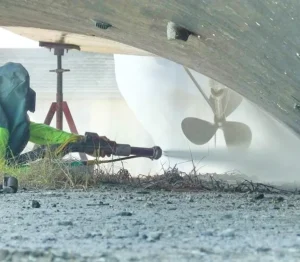
Abrasive blasting strips every coat down to bare gelcoat or bare metal in one pass and leaves a uniform surface profile the new barrier coat and antifouling can actually grip. That profile is the difference between bottom paint that holds for a full season and paint that’s peeling in sheets by the Fourth of July.
6 Honest Rules for Boat Bottom Paint Removal
1. Match the media to the hull, not the other way around
Aluminum hulls get soda or a fine glass media at low pressure, full stop. Run coarse slag or garnet on aluminum the way you would on a steel trailer frame and you will pit the metal, thin the plate, and open it up to corrosion you did not have before. Fiberglass and gelcoat hulls get a gentler abrasive too — the gelcoat is a coating, not armor, and blasting through it means a repair job nobody wanted. Steel-hulled vessels can take a more aggressive media and higher pressure, closer to what we run on a metal sandblasting job on a trailer or piece of equipment. Same price whichever media the hull needs — we pick by the material, never the invoice.
2. Soda blasting is usually the right call on gelcoat
For fiberglass hulls specifically, soda blasting is the media most owners should actually want. Sodium bicarbonate cuts through old antifouling and barrier coat without the aggressive tooth that sand or slag leaves, and it will not drive heat into the laminate the way some methods do. It costs a little more in media than sand, and it is the reason a soda-blasted hull still has its gelcoat intact underneath instead of a thin, fuzzy surface that eats extra barrier coat to seal back up.
3. Old bottom paint can be loaded with metals — contain the dust
Bottom paint’s whole job is releasing biocide, historically copper compounds and, on older hulls, tributyltin or even lead-based formulations from before those were phased out. That is not something you want drifting across a neighbor’s yard or into a lake. We work off tarps or a containment area, and any hull with an unknown paint history — especially anything painted before the 1990s — gets treated as if it may contain restricted compounds until we know otherwise. The EPA’s guidance on older lead-based coatings is a reasonable baseline for how seriously to take dust control on an older hull, even though it was written for buildings, not boats.
4. Watch the transom, thru-hulls, and trailer contact points
The thin aluminum around a transom cutout, the gelcoat right at a thru-hull fitting, the spots where trailer bunks or rollers have already worn the surface thin — those are exactly where a nozzle held too long in one place does real damage. We keep the gun moving, drop pressure near fittings and seams, and slow down at every edge instead of running the same setting across the whole hull. It takes longer. It is the only way the hull comes out the same shape it went in.
5. Prime or barrier-coat before the humidity gets to it
Bare aluminum and bare gelcoat do not wait around in Central Florida. A hull blasted Tuesday and left bare through a muggy Ocala weekend picks up flash corrosion on aluminum or moisture uptake on fiberglass before anyone rolls on a barrier coat. Our crew blasts and moves straight into priming or barrier coat the same day, which is the whole reason our painting and coating service rides on the same trailer as the blast pot. One crew, one day, no gap for Florida air to undo the prep work.
6. Know when not to blast
If a hull has one or two seasons of antifouling on sound gelcoat, a scuff sand and a fresh coat of bottom paint will do the job for a fraction of the cost, and we will tell you that on the phone before you book a truck. If the hull is thin-gauge aluminum already showing pitting under the paint, blasting can open up corrosion that was better left undisturbed until a proper hull survey happens first. We would rather lose a small job than leave you with a hull that is worse off than when we started.
What This Looks Like on a Marion County Haul-Out
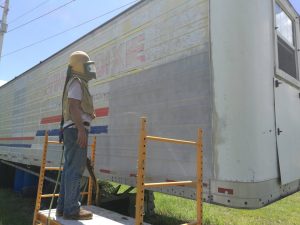
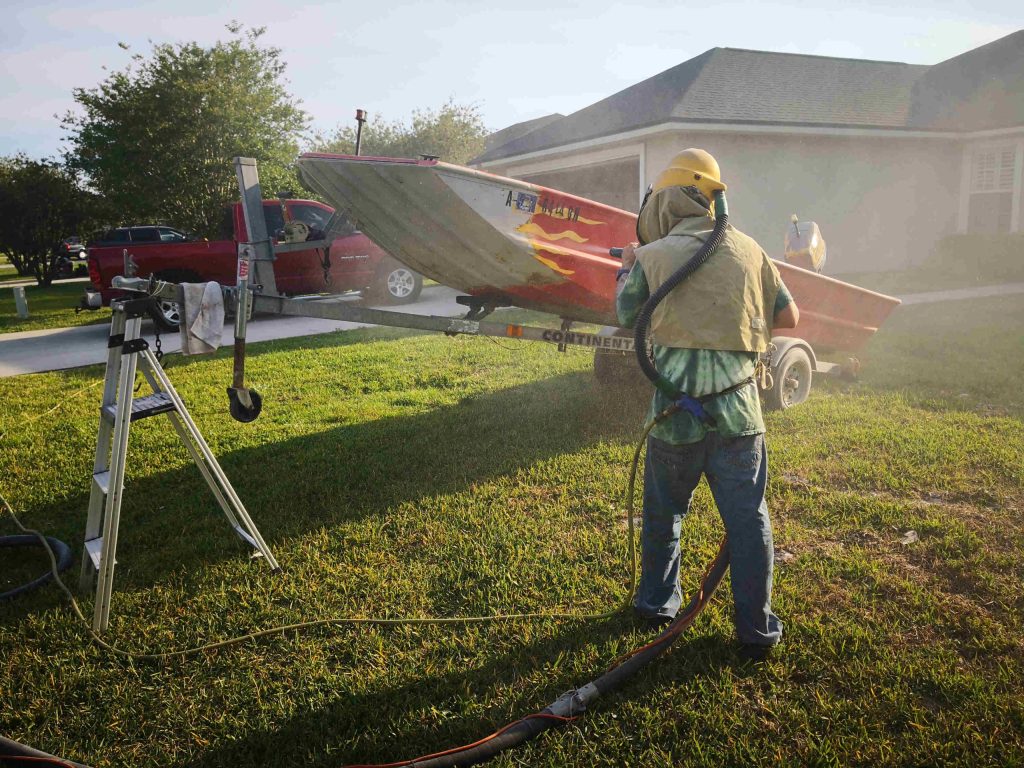
Most of our boat work in Ocala happens in a driveway or a farm outbuilding, not a marina — owners trailer the boat home, we set up on-site with containment, and the hull goes from stripped to primed in the same visit. Aluminum jon boats and bass boats off the lakes around Ocala and Belleview are the most common call: light growth, a few seasons of antifouling, sometimes a trailer that needs the same treatment the hull just got. Bigger fiberglass cruisers hauled out for a full bottom job take longer and usually get the soda treatment described above to protect the gelcoat. Either way, the rig comes to you, which beats a bottom job sitting on a yard’s waiting list through boating season.
When We Will Tell You Not to Hire Us
A quick recap, because this is the part competitors leave out. We will talk you out of a full strip when a scuff sand and fresh antifouling will hold for another season. We will tell you when pitting under the old paint means a survey should come before a blast pot. And if a Saturday with 80-grit and some elbow grease will genuinely get you there on a small hull, we will say so. The honest no is what earns the next yes, on boats the same as everything else we blast.
If your hull does need it, OSHA’s abrasive blasting guidance covers the safety and containment side of the work if you want the plain-English version before you book. Either way, you get a written estimate with one number on it — the number you approve is the number on the invoice.
Need sandblasting in Ocala or nearby? Call (352) 723-0181 for a free on-site estimate. You will reach someone who actually does the work.