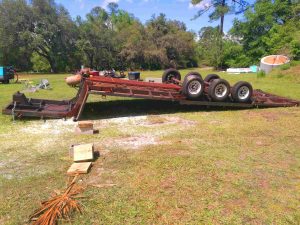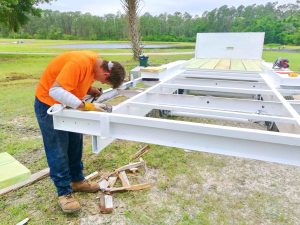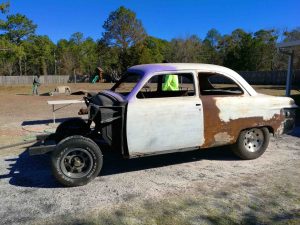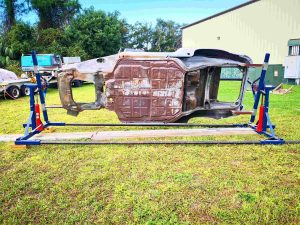
Farm equipment rust removal is the chore that waits until the bush hog deck has a hole you can put a fist through. Around Ocala the story repeats: the disc harrow sits at the back of the pasture, the hay rake lives under an oak, and the grease-caked implement hitch gets rained on every afternoon from June to September. Marion County humidity does not take a season off. Steel that touches it eats itself on a schedule you can set a calendar by.

Here is the honest part most people skip: rust on farm iron is rarely one problem. It is surface rust you can see, pitting you cannot, and sometimes a cracked weld hiding under both. Removing the rust is easy to say. Deciding whether the piece is worth saving takes a little more thought, and we would rather tell you that straight than blast something that should be scrapped.
Farm Equipment Rust Removal Starts With Reading the Steel
Before anything gets blasted, look at what the rust has already done. Flaking orange on a thick implement frame is cosmetic. Flaking orange on thin sheet metal, like a mower deck or a feed bin skirt, can mean the wall is gone underneath.
Take a hammer and tap it. Solid steel rings. Rotten steel thuds and sometimes dents. Poke any pitted area with a screwdriver. If the tip goes through, that section needs a patch plate or replacement, and blasting will only make the hole bigger and more obvious.
Thick pieces such as disc gangs, three-point hitches, tool bars and draw bars are usually great candidates. They have the mass to lose a little surface and keep their strength. Thin sheet is a judgment call. We will tell you which side of the line your piece falls on when we look at it.
Why Wire Brushes and Grinders Fall Short on Implements
A wire wheel on a grinder is fine for a bracket. On an implement it is a long weekend that leaves rust behind. Farm iron is full of welds, corners, bolt heads, pivot points and tight seams. A wire wheel skates right over the pits where rust lives, polishes the surface of the rust instead of removing it, and leaves a smooth finish that paint will not grip.
Rust left in the pits keeps working under new paint. You see bubbling in a season, sometimes less in Florida humidity. That is the number one reason a fresh paint job on a tractor attachment fails, and it is a prep failure, not a paint failure.
Abrasive blasting does what hand tools cannot. It cuts rust and mill scale out of the pits, strips the old coating in the same pass, and leaves a rough anchor pattern, the surface profile, that primer bites into. If you want the background on how that works, our post on sandblasting versus chemical stripping walks through it, and the rust removal methods comparison covers hand tools, chemicals and blasting side by side.
Which Implements Make the Best Blasting Jobs
Not everything with rust on it is a great blasting job. Here is how the common Ocala farm and ranch equipment sorts out.
Bush hog and rotary cutter decks. The top of a deck is easy. The underside is where grass moisture sits, and it is usually the worst. Blasting both sides is worth it if the deck steel is still thick. If the underside is thin and flaking in sheets, patch it first or walk away.
Disc harrows and tillage tools. The discs themselves are meant to wear, so we do not chase a mirror finish on the cutting edges. The frame, gang bolts, hitch and bearing housings are what get saved. Protect bearings or pull them.
Hay equipment. Rakes, tedders and balers live outdoors and rust at every bolt. Frames blast well. Chain, sprockets and anything with tight tolerances needs to come off first or be masked.
Gates, feeders and cattle or horse panels. Tube steel and welded panels are straightforward. Galvanized panels are a different conversation, since blasting removes the zinc. If the galvanizing is mostly intact we may tell you to leave it alone.
Tractor parts and loaders. Buckets, forks, grapples, brush guards and draw bars all do well. Painted tractor sheet metal depends on thickness and body filler. Be honest with us about any previous repair work.
The Prep Work You Do Before the Rig Shows Up
Because we are mobile, the rig comes to your barn aisle or your pasture gate. A little prep on your end saves a lot of headache.
Drain fluids and remove batteries, hoses and anything rubber you do not want blasted. Rubber and plastic do not survive an abrasive stream, and hydraulic fittings are easy to damage. Grease fittings, bearings and seals should be pulled or masked. Park the equipment where we can walk all the way around it, preferably on level ground with a few feet of working room.
Tell us what the piece does. A hay rake and a front-end loader bucket do not need the same finish. Tell us about previous paint, too. Older equipment, especially anything painted before the late 1970s, can carry lead-based paint, and that changes how it has to be handled. The EPA publishes guidance on this at its lead renovation, repair and painting program page, and our post on lead paint safety on older Florida buildings applies to old farm iron too.
Dry, Dustless or Something Gentler
Which method fits depends on the steel and the setting. For heavy implement frames, a dry or abrasive blast moves fastest and gives the best anchor profile. Where dust is a concern near stalls, hay storage or neighbors, our dustless blasting option keeps the dust down, with the trade-offs we have always been upfront about: it is wet, it leaves a slurry to deal with, and it can flash rust fast if the steel is not handled right afterward.
For lighter or more delicate pieces, a gentler media avoids pitting thin metal. If you are unsure, ask us. We pick the media to fit the job, not the other way around. For general questions about worker safety and abrasive blasting practices, OSHA’s abrasive blasting page is the place to start, and it is the standard we hold ourselves to on every site.
The Florida Rule: Prime It the Same Day
This part matters more than the blasting. Bare steel in Marion County starts flash rusting within hours, sometimes before you finish lunch. Our post on flash rust on bare steel in Ocala explains why. The practical result is simple: blast it and coat it the same day, or you are paying to rust it again.
That is why we blast and coat with the same crew. We prime the bare steel before supper, then topcoat when the primer is ready. Our painting services cover the coating side so the piece leaves finished, not exposed. If you plan to coat it yourself, tell us. We will leave the surface in the condition your primer needs and give you a realistic window to get it covered.
When Not to Blast Your Equipment
Sometimes the honest answer is no. A tractor with a cracked frame is a welding job. A mower deck that is more patch than steel is a replacement. A piece you plan to sell for scrap is not worth the effort. And if the equipment is lightly surface-rusted and you are comfortable with a wire brush, a rust converter and a Saturday, do that.
We would rather lose the job than hand you a nice-looking piece of steel that is about to fail. That is also why we look at the equipment before we quote it. You can read more about the process on our metal sandblasting page, and our earlier post on sandblasting horse trailers and farm equipment covers the trailer side of the same problem.
Keeping Rust From Coming Back
Good coating only lasts if you give it a fair chance. Wash off fertilizer, manure and mud after use, because those hold moisture and are corrosive. Touch up chips right away, before they open the door to rust. Store equipment off bare ground when you can, and under cover if possible. Put a fresh coat of grease on pivot points and keep them moving.
A properly prepped and coated implement can hold up for years in Central Florida weather. A badly prepped one can fail in a season. The difference is nearly always the prep.
Getting a Real Look at Your Equipment
Photos help, but nothing beats having someone walk around the piece. We come to your property, check the steel, tell you what is worth saving and what is not, and give you a written quote. The number you approve is the number on the invoice.
Need sandblasting in Ocala or nearby? Call (352) 723-0181 for a free on-site estimate. You will reach someone who actually does the work. You can also reach us through our contact page.
Ocala Sandblasting | (352) 723-0181 | https://ocalasandblasting.com/