If you have a rusted gate, a painted trailer, or a barn door full of forty years of coatings, you are eventually going to stand there and ask the same question everybody in Marion County asks: strip it or blast it? Sandblasting vs chemical stripping is not a trick question, and it is not a matter of which one is “better.” They do genuinely different things to a surface, and the job in front of you usually already picked the winner before you did.
Here is the honest part most people skip: a lot of the stripping horror stories out here are not because somebody used the wrong product. They are because somebody used a method that was never going to give them the surface the next coating needed.
Sandblasting vs Chemical Stripping: What Each One Actually Does
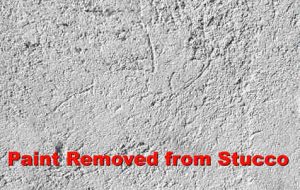
Chemical stripping works by attacking the coating itself. A solvent or caustic gel softens the paint film, breaks its bond, and turns it into something you can scrape, pressure rinse, or wipe off. The metal or wood underneath is supposed to be left alone.
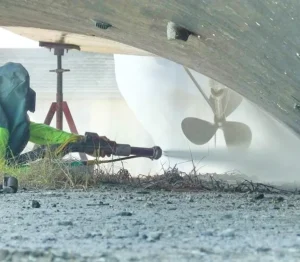
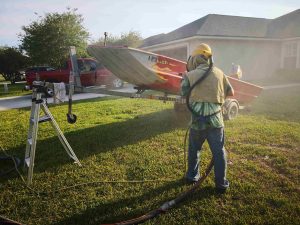
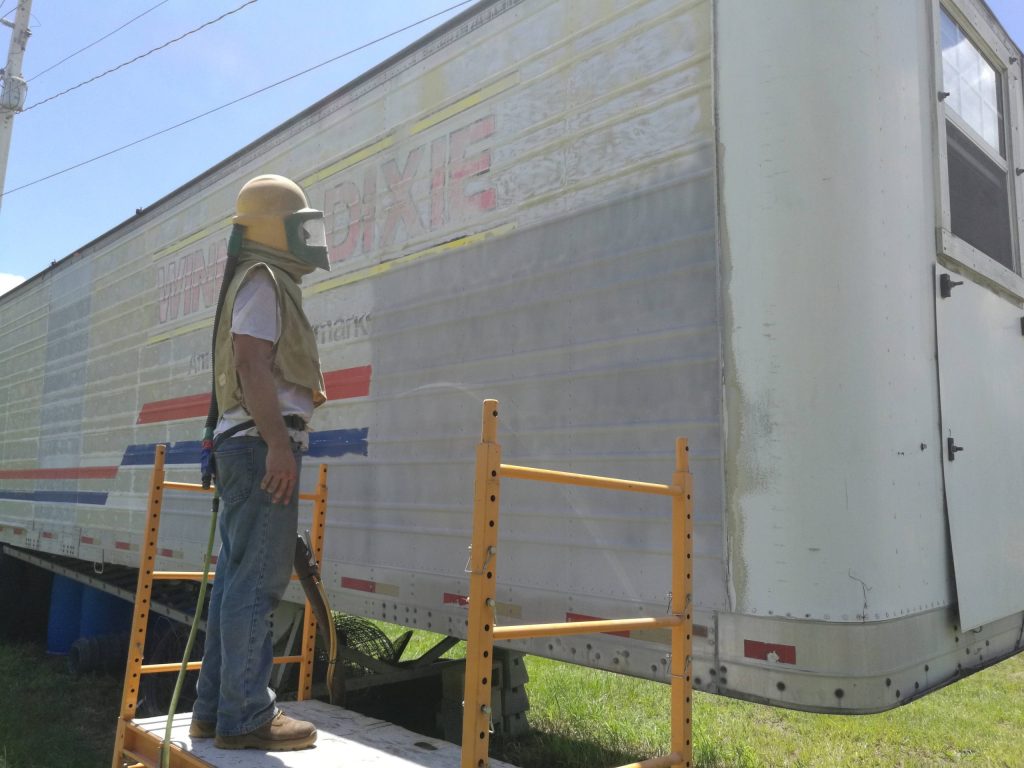
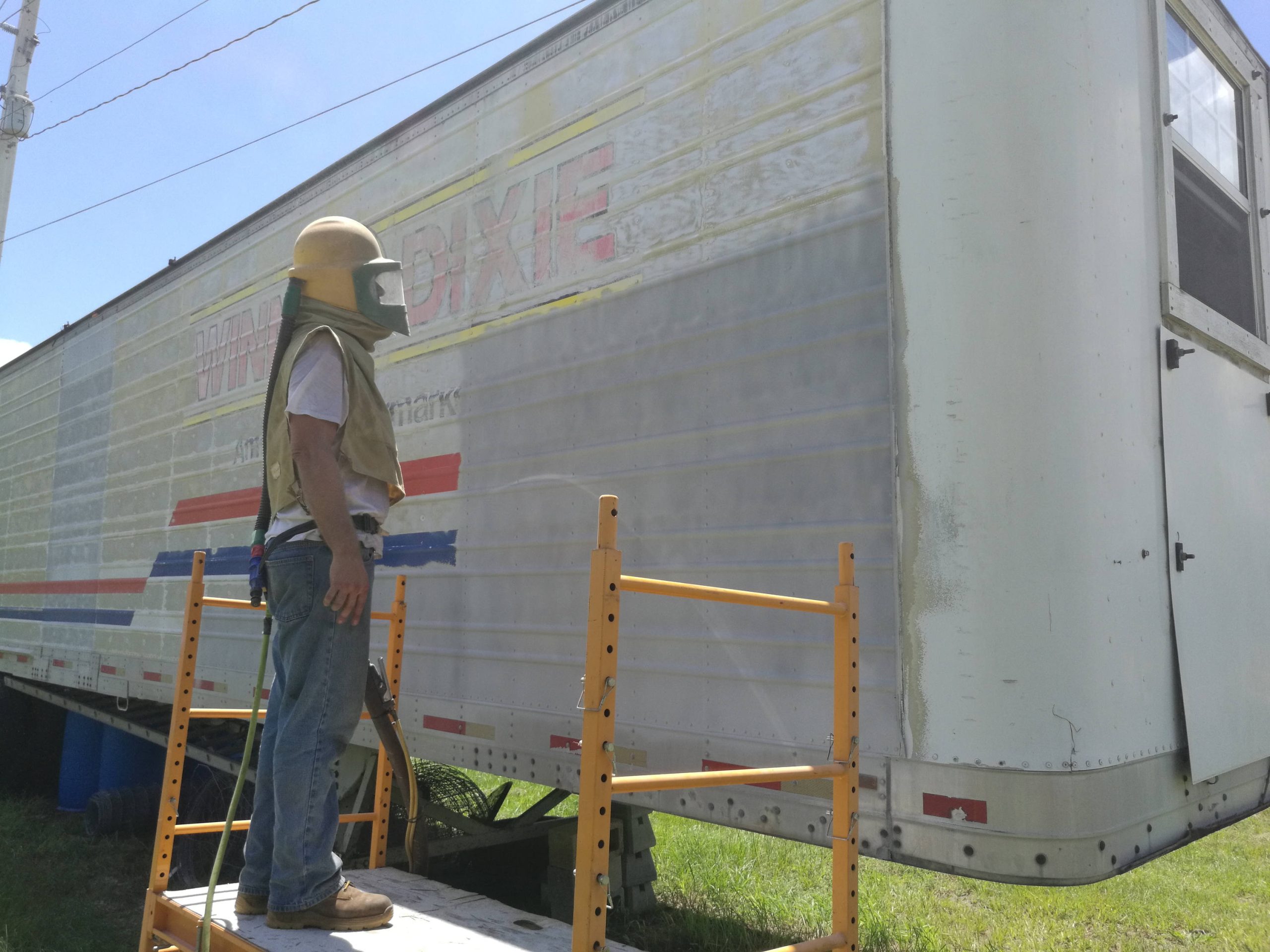
Abrasive blasting works by hitting the surface with media at pressure. The coating does not dissolve. It shatters and gets carried away, along with rust, mill scale, and whatever else is sitting on top. The surface underneath does not stay untouched, and that is the whole point.
So the short version: chemicals take the coating off. Blasting takes the coating off and resets the surface. If you only ever remember one thing from this page, remember that.
Rule 1: If the Next Step Is Paint, You Probably Need Profile
Coatings do not stick because they are sticky. They stick because they grab into thousands of tiny peaks and valleys in the surface. That texture is called profile, and it is measured in mils. Most industrial primers want somewhere in the 1.5 to 3 mil range, and the coating manufacturer prints the number they want right on the data sheet.
Chemical stripping does not create profile. It cannot. It removes what is on top and hands you back a smooth, chemically clean surface. That is fine if you are refinishing furniture. It is a problem if you are about to put an epoxy primer on a steel gate that lives outside in Ocala.
Blasting sets the profile and the cleanliness in the same pass. That is why our metal sandblasting work in Ocala almost always ends with a surface that is ready to prime rather than ready for another step.
Rule 2: Rust Does Not Care About Stripper
This is where a lot of DIY jobs go sideways. Chemical strippers are formulated for coatings, not corrosion. You can strip a rusty trailer frame down to bare paint-free steel and still be looking at pitted, scaly rust in every low spot.
Around here that matters more than it would up north. Between the humidity, the afternoon storms, and the ammonia in a barn aisle, farm and equestrian steel in Marion County rusts from the inside of every seam outward. Mill scale and pitting have to come off mechanically. Media does it. Gel does not.
If your surface is more rust than paint, the sandblasting vs chemical stripping debate is basically over before it starts.
Rule 3: Detail, Thin Metal, and Soft Wood Change the Answer
Now the other side, because we are not going to pretend blasting wins everything.
Blasting is aggressive by design, and aggressive is not always what you want. Thin sheet metal can oil-can or warp if somebody runs too much pressure with too hard a media. Ornamental castings with crisp detail can get rounded off by a heavy hand. Old heart pine and cypress will lose their soft summer growth and go furry if the operator treats it like structural steel.
None of that means blasting is wrong for those jobs. It means the media and the pressure have to match the surface. Soda, walnut shell, glass bead, and low-pressure setups exist exactly for this. Our wood sandblasting in Ocala runs at a completely different setting than a tractor frame, because the wood would not survive the tractor settings.
But if you have a small piece of intricate hardware, a single antique door, or something with a finish you want preserved underneath, chemical stripping done carefully is a real option. We will tell you that.
Rule 4: Time and Weather Are Part of the Comparison
Chemical stripping is a waiting game. Apply, dwell, sometimes cover it, scrape, neutralize, rinse, dry, repeat on the spots that did not release. On a heavy multi-layer coating, that is often two or three rounds.
Blasting is measured in square feet per hour, and it happens in one pass. That is not just a convenience argument in Central Florida. Bare steel here starts flash rusting before supper, and a summer afternoon storm can undo a whole day of prep on an unprimed surface.
That is the practical reason we push same-day priming so hard. When one crew blasts and coats, the window between bare metal and protected metal stays short. A chemical strip that requires rinsing, drying, and neutralizing stretches that window out, and every hour of it is an hour the humidity gets a vote.
Rule 5: The Mess Is Different, Not Smaller
People assume chemicals are the tidy option. Sometimes. Not always.
Blasting makes dust and spent media. It is visible, it needs containment, and on a horse farm it needs to be kept out of hay, water troughs, and stalls. That is a real consideration and we plan for it. If dust control is the main worry, dustless blasting in Ocala knocks most of it down with water, though it trades one problem for another: you get slurry and a wet surface instead of dust.
Chemical stripping makes sludge. That sludge is a mix of solvent and old coating, and it has to be contained and disposed of properly, not hosed into the pasture. Strippers also come with real ventilation and skin-contact requirements. OSHA’s abrasive blasting guidance covers the blasting side of that equation, and it is worth reading if you are considering doing any of this yourself.
And if the building is pre-1978, neither method gets a free pass. Lead paint has its own federal rules regardless of how you remove it, under the EPA’s Renovation, Repair and Painting program.
Rule 6: Sometimes the Honest Answer Is Neither
If a wire brush, a scraper, and a Saturday morning will handle it, we will tell you that instead of quoting it. A single flaking porch rail is not a blast job.
And sometimes the answer is both. On a heavy build-up of soft, gummy coating, chemicals can knock the bulk off so the blast pass afterward runs clean and fast instead of gumming up the media. That is a legitimate sequence, not a compromise.
How We Actually Decide on an Ocala Job Site
When we walk a job, we are answering four questions in order:
What is the substrate? Steel, aluminum, brick, concrete, and wood all behave differently and all want different media.
What is coming off? One thin layer of latex is a different job than five layers of alkyd over mill scale.
What is going on next? If a high-performance coating is going on, we need a specified profile, and that decides it. If we are handling the painting in Ocala too, we are prepping to our own standard, which tends to make the decision simpler.
Where is it? A gate we can pull and bring back is different from a barn we have to work around horses in. Site access, containment, and neighbors all matter.
Same price either way, by the way. We pick the method by the job site, never by the invoice.
The Short Version
Choose chemical stripping when the piece is delicate, the detail is fine, the coating is the only thing you want gone, and no profile is required. Choose blasting when there is rust, when there are layers, when time and weather are working against you, or when a coating has to bond and stay bonded. On most of what we see in Marion County, that second list is the one that describes the job.
If you are not sure which one your project wants, we will look at it and tell you straight, including if the answer is that you do not need us.
Need sandblasting in Ocala or nearby? Call (352) 723-0181 for a free on-site estimate. You will reach someone who actually does the work.