Why does paint peel off metal? Nine times out of ten, the paint was never the problem. If you are standing in an Ocala barn aisle looking at a gate that was painted two summers ago and is already curling off in sheets, you are not alone, and you probably did not buy bad paint. The metal underneath was not ready for it. Here are the six causes we see most often in Marion County, and what actually fixes each one.

Paint does not stick to metal the way tape sticks to a box. It grips the tiny peaks and valleys on the surface, and it needs that surface to be clean, dry and free of anything loose. Take any of those away and the coating is just a thin film resting on top, waiting for the first hot, wet week to lift it. In Central Florida that week arrives about every Tuesday.
Cause 1: Rust Under the Paint
This is the big one. Somebody wire-brushed the loose flakes, rolled paint over what was left, and called it done. Rust that stays under paint keeps growing. It swells, it pushes the coating up from below, and the paint blisters and peels in patches that follow the rust. If you scrape a peeled spot and find orange powder on the back of the paint chip, that is your answer.
Here is the honest part most people skip: a rust-converter or a “paint over rust” product can slow this down on a fence you do not care about. On a trailer, a gate, or a piece of equipment you want to last, it only delays the peel. The rust has to come off the metal, all the way to clean steel. That is exactly what our metal sandblasting in Ocala work is for.
Cause 2: No Profile on the Surface
Profile is the microscopic texture that gives paint something to hold. New steel often comes with a smooth, glossy mill scale. Old steel can be polished slick by years of weather and hand rubbing. Sand it lightly and you scuff the top, but you do not build real profile. Abrasive blasting does. The media leaves a consistent, angular texture, and the coating locks into it.
The coating industry measures this. The SSPC publishes surface preparation standards that spell out how clean and how rough a surface needs to be before a given coating goes on. You can read more at SSPC. You do not need to memorize the numbers. You just need to know that “it looks clean” and “it is ready” are two different statements.
Cause 3: Flash Rust Between Prep and Paint
Bare steel in Florida humidity starts rusting within hours. We have watched a freshly blasted panel go from silver-gray to a light orange haze before lunch on a muggy August morning. If a surface was cleaned on Saturday and primed on Monday, the primer went over a fresh film of rust whether anyone saw it or not.
That film is weak. Primer grips it, and it grips the steel only through the rust. Put a few thermal cycles and a few rainstorms on top and the whole sandwich lets go. The fix is boring and effective: prime the same day the metal is exposed. It is one reason we blast and coat in the same visit. You can see how that works on our painting services in Ocala page.
Cause 4: Dirt, Oil, Salts and Old Chalk
Barns and shops are greasy places. Hay dust, hydraulic fluid, cooking oil in a kitchen exhaust, a decade of hand oils on a railing. Paint does not bond to any of it. Even a thin film you cannot see can make the coating bead up, fish-eye, or peel in sheets six months later.
Then there are soluble salts. Metal near water, near fertilizer, or near a lot of road spray can carry invisible salts in the pores. Those salts pull moisture through the paint like a wick and cause blisters. Pressure washing alone does not always remove them. Proper blasting, followed by a clean wipe-down, usually does. If you want the full comparison of options, our post on sandblasting versus pressure washing in Ocala goes through it step by step.
Cause 5: The Wrong Paint for the Job
A good coating on the wrong surface fails just as fast as a bad coating on the right one. Some common mismatches we run into:
- Latex wall paint rolled onto a steel door or trailer fender, where it needed a primer rated for metal.
- A topcoat that does not match the primer under it, so the two layers fight each other and separate.
- Interior-grade paint used outdoors, where UV and moisture break it down in a season or two.
- A thick coat applied to metal that expands and contracts in the sun, which cracks the film at the edges.
There is no shame in this. Paint aisles are confusing, and the label on the can says it works on everything. It does not. If you are not sure what is already on the metal, tell us. We will look at it and say what we think before anyone touches it.
Cause 6: Old Paint That Was Already Failing
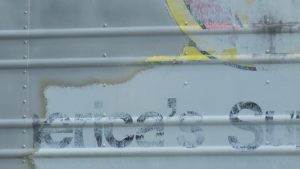
Sometimes the problem is not your paint at all. It is the layers beneath. A fence or gate that has been painted five or six times carries a thick stack of coatings. The oldest ones lose their grip first, and when you paint over them, your new coat is only as strong as the weakest layer under it. When that bottom layer lets go, everything above it peels together.
On older Marion County properties there is another wrinkle. Buildings and equipment from before 1978 can have lead in the old paint. If you suspect it, do not dry-scrape or sand it yourself. The EPA has guidance on this at the EPA lead renovation program page, and we cover it in our post on lead paint safety on older Florida buildings.
So What Actually Fixes Peeling Paint on Metal?
You have to go back to the root cause, not just the symptom. In order:
- Remove everything that is failing. Loose paint, rust, mill scale and old chalk all go. If the coating is sound and tight, it can stay.
- Build real profile. Abrasive blasting is the most reliable way to do this on steel, iron and many other metals.
- Clean the surface. Remove oil, dust and residue before anything goes on.
- Prime the same day. Do not give flash rust a chance.
- Use a coating system made for the metal and the exposure. Primer and topcoat should be designed to work together.
That is the whole secret, and nobody sells it in a can.
When You Do Not Need Us
We would rather tell you straight. If you have a small patch of peeling paint on a single fence post, and the rest of the coating is tight, a wire brush, a scuff, a spot prime and a Saturday will probably do the job. That is a fair fix for a small problem, and we will say so on the phone.
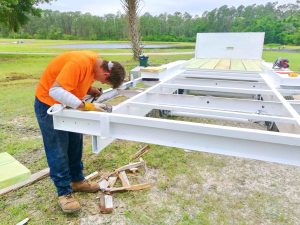
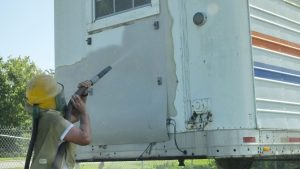
Where we earn our keep is the bigger jobs: a whole gate that keeps failing, a trailer you want to keep for another twenty years, a set of stall fronts, a steel stair, or any metal where the same repaint keeps coming back. For heavy rust or old coatings on a larger piece, we use dry abrasive methods. For jobs where dust is a concern, our dustless and green blasting in Ocala is an option, with the trade-offs we explain up front. It is wetter and messier in its own way.
What Peeling Paint Looks Like in Ocala Horse Country
Marion County is hard on paint. Long summers, heavy afternoon storms, high humidity and strong sun mean metal spends most of the year either wet or hot. Livestock add ammonia and moisture around stalls, gates and troughs. Board-fence hardware, feed room doors, trailer floors and tack-room hinges all see more abuse than the same parts would in a dry climate.
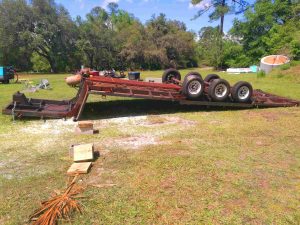
That means prep matters more here than it does in most places. A coating that would survive five years in a mild climate can fail in two if it goes on over a weak surface. We see this on horse trailers, stall guards, pipe corrals and farm gates every year. The good news is that a job done right the first time holds up. A properly prepped and primed surface does not care how humid Tuesday is.
The Short Version
Paint peels off metal because of rust under it, no surface profile, flash rust before priming, contamination, the wrong coating, or old failing layers beneath. Fix the cause and the paint stays put. Skip it and you will be scraping again next summer.
Ocala Sandblasting | (352) 723-0181 | https://ocalasandblasting.com/
Need sandblasting in Ocala or nearby? Call (352) 723-0181 for a free on-site estimate. You will reach someone who actually does the work.