If you have read anything online about dustless vs dry sandblasting, you were probably told dustless is the modern, cleaner, better way and dry blasting is old news. We do both every week, so here is the honest version — because most of what gets written about dustless vs dry sandblasting leaves out the parts that actually matter on a real job.
Start with the one thing both methods share: they clean equally well. The cutting power is the same. So the real question in dustless vs dry sandblasting is never which one strips better – it is which mess your job can live with.
Dustless vs Dry Sandblasting: The Real Difference
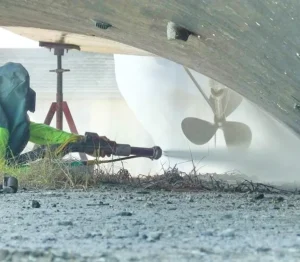
Dry blasting fires abrasive with compressed air and throws a cloud of dust. Dustless mixes water into that same abrasive so the dust drops at the surface instead of drifting. That is the whole headline – dustless trades a dust cloud for water. Everything good and everything bad about it comes from that water.
The Downsides of Dustless Nobody Puts on Their Website
Here is the part the glossy articles skip. The water that kills the dust turns the whole job into a wet, muddy mess. Spent media plus water makes a slurry that gets into everything, and once it dries it packs hard into seams, bolt heads, and tight corners. With dry blasting you can blow the leftover dust out of every nook and cranny with air when you are done. With dustless you cannot – the mud is in there wet, and good luck getting it back out of a complicated part.
Bigger problem, and the one that costs people money: you do not want to paint over the mud-coated metal that dustless leaves behind. That film is wet spent abrasive sitting on bare steel. Coat over it and three things go wrong – the paint bonds to the mud instead of the metal and peels; trapped moisture flash-rusts under the coating and blisters it; and the salts in that residue pull in more moisture and blister it again. So dustless forces an extra step dry blasting does not: let it dry, wash the mud and salts off, make sure it is truly dry, and only then prime.
It is not just our opinion. A lot of quality primers will not hold over a damp, salty surface – the two-part epoxies and the zinc-rich primers especially are written to go over a dry, clean, salt-free surface, which is exactly what freshly dustless-blasted metal is not until it has been cleaned and dried. [Owner note: drop in the specific products you have seen fail over dustless here and we will name them.]
So Why Run Dustless at All?
Because sometimes the dust is the bigger problem. Inside an occupied barn, next to a neighbor’s pool or screened lanai, near a busy storefront, around livestock and feed – a dry dust cloud is not acceptable, and that is exactly where our dustless blasting earns its keep. We are not against it. We run it all the time. We just run it where it belongs and tell you the truth about the cleanup.
When Dry Blasting Is the Better Call
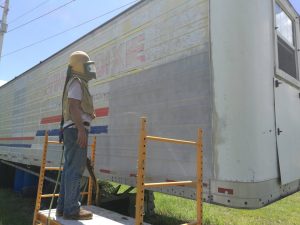
Out in the open – pasture steel, a trailer on a driveway, equipment in a lot with nobody downwind – dry blasting is faster, cleaner to finish, and easier to coat the same day because there is no mud to deal with first. On complicated metal parts with lots of nooks and crannies, dry is usually smarter too, because you can blow it out clean. A lot of the time, honestly, dry is the better technical choice.
We Do Both – At the Same Price
Here is the part that makes this easy: we do dry and we do dustless, and neither one costs more than the other. There is no upcharge for the fancy one. We pick the method by your surroundings and your surface, not by what pads the invoice, and we will tell you which one your job actually wants. If dust is a problem, we go dustless and plan the extra cleanup. If it is not, we go dry and get you coated faster by the same crew that handles painting and coatings.
That honesty is the whole point. Anyone can sell you dustless as a miracle. We would rather tell you what it really does on your job. For the safety side of abrasive work, the OSHA abrasive blasting guidelines are the reference we work to.
Need sandblasting in Ocala or anywhere in Marion County? Call 352-723-0181 for a free on-site estimate, or request a quote online.