Walk into any supply house and you will see a whole wall of blasting abrasive types — garnet, coal slag, glass bead, crushed glass, aluminum oxide, walnut shell, soda. Most of the folks selling the bags have never pointed a nozzle at a rusted farm gate in a Florida July. Here in Ocala, three abrasives do the bulk of the honest work: garnet, coal slag, and glass bead. Pick the right one and the job runs fast and the coating sticks for years. Pick the wrong one and you can warp a fender, bury a pasture corner in black grit, or cut a profile so rough no paint can level it.
Here is the straight version — what each abrasive actually does, where it wins, where it lets you down, and the seven rules we use to choose on real Marion County jobs.
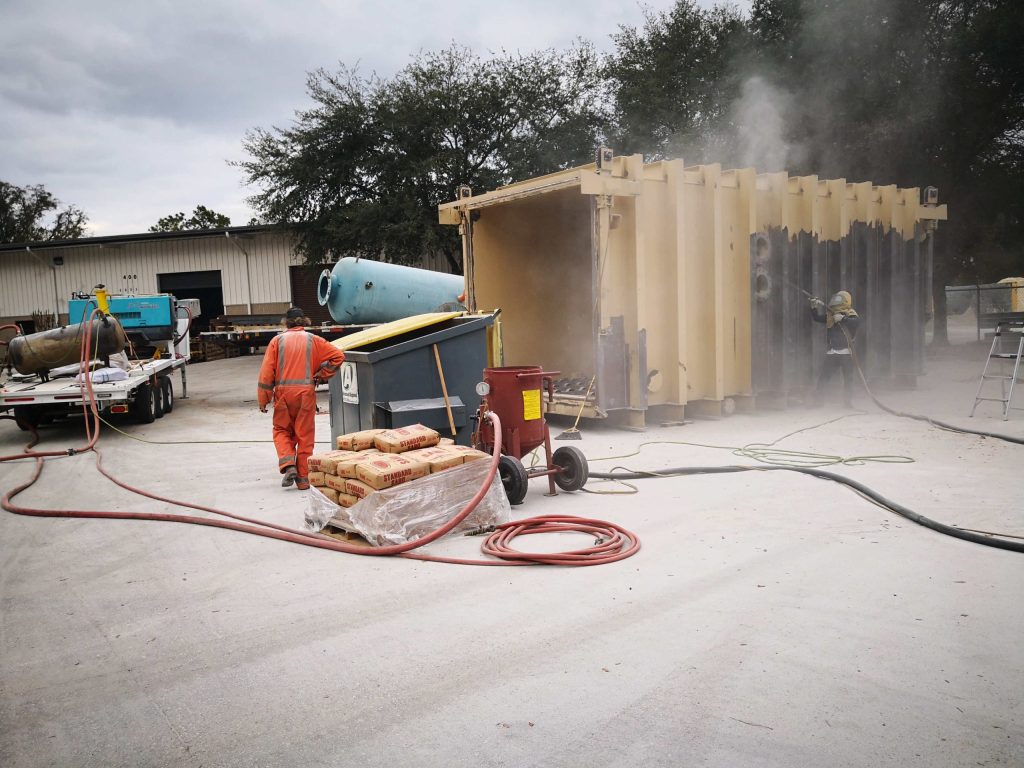
Blasting Abrasive Types: What Actually Matters
Every abrasive comes down to four things: how hard it is, what shape it is, how much dust it throws, and what it leaves behind. Angular grit cuts. Round media peens — it hammers the surface smooth instead of slicing into it. That difference decides everything.
The number that matters most is profile — the tiny peaks and valleys the abrasive carves into the metal, measured in thousandths of an inch. Coating manufacturers print the profile they want right on the data sheet, usually somewhere around 2 to 4 mils for industrial primers. Too shallow and the coating peels. Too deep and the peaks poke through the paint film and rust from the inside out. The abrasive you choose is the main lever that sets that profile. It is not a detail. It is the job.
Garnet: The All-Rounder That Earns Its Keep
Garnet is a dense natural mineral, angular enough to cut but clean enough to leave a tight, consistent profile. It throws far less dust than slag, it cuts fast, and it does not embed junk into the steel the way softer abrasives can. When a trailer frame or a structural piece is getting a serious coating system afterward, garnet is usually what we reach for.
The honest downside: it is a premium abrasive, and hauling it is heavy work. For knocking old paint off a thick pipe gate that is just getting a farm-grade enamel, garnet is more abrasive than the job deserves. A good crew matches the media to the job, not to what is sitting in the trailer.
Coal Slag: The Workhorse With a Dirty Secret
Coal slag — the black grit most people picture when they think of sandblasting — is the workhorse of the trade. It is aggressive, it is angular, and on heavy rust, mill scale, and thick structural steel it flat-out moves. Stock trailer frames, implement frames, steel posts: slag eats that work.
Now the dirty secret, and it is literal. Slag shatters on impact and throws a lot of dark dust and fines. It can leave gray-black specks embedded in the surface, and once it is spread across a barn aisle or a pasture corner, you are not getting it all back. It is also the wrong answer on aluminum and thin sheet metal — too much bite, too much heat, and thin panels can warp before you know it. Slag is a one-way trip, too: it breaks down on the first pass, so there is no reclaiming it in the field.
None of that makes slag bad. It makes slag a tool with a lane. Keep it on heavy steel, plan the cleanup, and it earns its reputation.
Glass Bead: The Finish, Not the Fight
Glass bead is the odd one out because it is round. Instead of cutting, the beads peen the surface, leaving a soft satin finish that looks fantastic on aluminum, stainless, and machined parts. Bead is gentle, it can be recycled several times in a cabinet, and it will not chew up a part you care about.
What bead will not do is fight. Heavy rust, thick coatings, mill scale — bead just polishes the top of the problem. And because it leaves almost no profile, a coating applied over a beaded surface has little to grab. If the part is getting painted afterward, tell your blaster, because bead alone is usually the wrong prep. Bead is a finish choice, not a demolition choice.
7 Honest Rules for Choosing Between Them
- Match the abrasive to the metal, not the habit. Thick steel forgives almost anything. Aluminum and sheet metal forgive almost nothing. The crew that runs slag on an aluminum trailer skin because slag is what they always run is the crew that hands you back a warped trailer.
- Let the coating pick the profile. The data sheet on the primer says what profile it needs. Read it, then choose the abrasive that produces it. Feel and guesswork are how coatings fail in year two. The SSPC surface prep standards exist for exactly this reason.
- Heavy rust wants angular grit. If the metal is scaling, do not bring beads to that fight. Slag or garnet, full stop.
- Bare metal or satin look? Bead it. If the part is staying uncoated or you want that clean matte finish on aluminum or stainless, glass bead is the right call — and the gentlest one.
- Think about where the spent media lands. On a horse farm, this is the rule people skip. Slag fines in a paddock or a barn aisle are a real cleanup problem. Garnet and crushed glass run much cleaner, and containment matters more than most outfits admit.
- Never let anyone blast with plain sand. More on that below. It is not a cost decision, it is a lungs decision.
- When two abrasives both work, pick by the job site, never the invoice. Same crew, same day either way. The right answer is the one the surface and the surroundings want.
What About Plain Old Sand? Don’t.
Actual silica sand — beach sand, play sand — shatters into fine crystalline silica dust when it hits steel, and breathing that dust causes silicosis, an incurable lung disease. OSHA’s abrasive blasting guidance is blunt about it, and so are we: we do not run silica sand, and you should not let anyone run it on your property. Florida humidity clumps it in the pot anyway. There is no upside. Every abrasive above does the job better and safer.
How This Plays Out in Ocala Horse Country
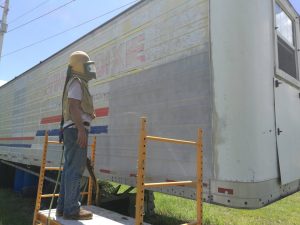
Marion County work has its own personality. A rusted pipe gate or a stock trailer frame off a farm on 326? That is angular-grit territory — heavy cut, then primer the same day, because bare steel in our humidity starts flash rusting before supper. An aluminum feed trailer or an outboard bracket? Bead or soda blasting, because those surfaces punish aggression. Steel that is getting a real coating system — railings, structural pieces, equipment frames — gets garnet and a measured profile as part of our metal sandblasting work in Ocala.
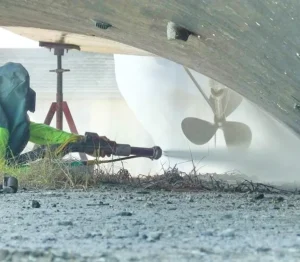
And when the job sits close to stalls, paddocks, or a neighbor’s fence line, containment drives the choice as much as the metal does. That is where dustless green blasting earns its keep — it knocks the dust down when open blasting would coat everything downwind. It is not the right answer for every job, but near animals it is often the considerate one.
One more honest note: if all you have is one gate panel with light surface rust, a wire wheel on a grinder and a Saturday will do fine. We will tell you that on the phone. The jobs that want a blaster are the ones where the rust is winning, the coating matters, or there is simply too much steel for hand tools.
We blast and coat with the same crew, usually the same day, and we will tell you straight which abrasive your job wants — and why.
Need sandblasting in Ocala or nearby? Call (352) 723-0181 for a free on-site estimate. You will reach someone who actually does the work.