Surface prep before powder coating is the part of the job nobody photographs and everybody blames later. The powder goes on looking perfect. Six months into an Ocala summer, it starts lifting at an edge, and the coater gets the phone call even though the coater did nothing wrong. Nine times out of ten the failure happened before the part ever reached the oven. Here is the honest part most people skip: powder is a thin, hard shell. It does not soak in, it does not bite through grease, and it does not fix a bad surface. It copies whatever is underneath it.
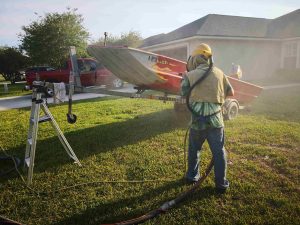
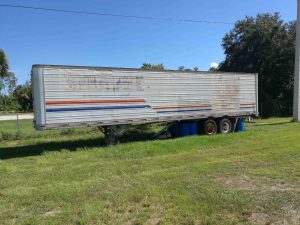
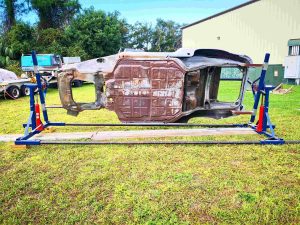
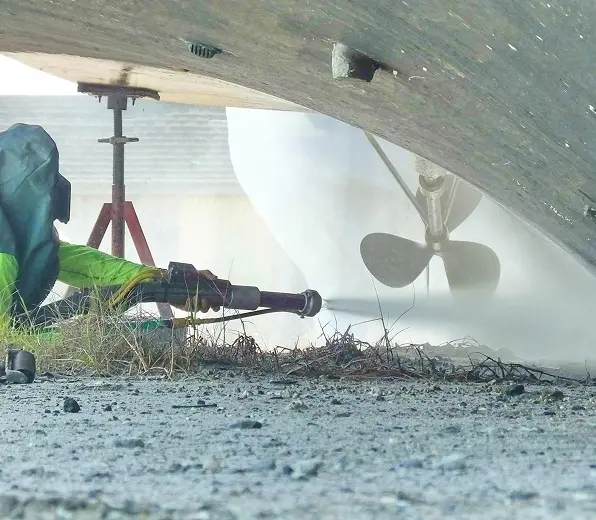
We blast steel in Marion County all week — gate panels, stall fronts, trailer frames, bracketry, mower decks, arena drag parts. A lot of it is headed to a powder coater afterward. This is what we have learned about getting steel ready so the finish actually holds.
Why surface prep before powder coating decides whether the finish lasts
Powder coating is an electrostatic process. Dry powder is charged, sprayed onto a grounded part, then baked until it flows out and cures into one continuous film. There is no solvent, no primer soaking into pores, no second chance. Adhesion comes from two things and two things only: a clean surface and a mechanical profile for the powder to key into.
Miss either one and you get the failures every coater recognizes on sight. Fisheyes and craters, where silicone or oil rejected the powder. Blisters, where moisture or soluble salts were trapped under the film. Edge peel, where rust was still sitting in a pit and kept growing in the dark. Once powder lifts, it lifts in sheets, because that hard shell has no flexibility to feather out. You do not touch up powder. You strip it and start over.
That is why proper prep is cheaper than it looks. It is the only step that determines whether you do this once or twice.
Rule 1 — Powder hides nothing, so the steel has to be honest first
Wet paint is forgiving by comparison. It wets out, it flows into a scratch, a decent primer will bridge a small sin. Powder does not. It cures to a uniform thickness and telegraphs everything below it: weld spatter, a grinder gouge, a seam that was never closed, mill scale that is half hanging on.
So decide up front what the part needs to look like. If it is a mower deck or a trailer crossmember, cosmetics do not matter and blasting to bare metal is the whole job. If it is an ornamental gate panel for a farm entrance on County Road 225, the welds want dressing and the pits want addressing before the blast, not after. Blasting will not fill a pit. It will clean the pit out and make it more visible, which is honestly the right outcome — now you can see what you are dealing with.
Rule 2 — Oil and barn grime come off before the abrasive ever starts
This is the mistake we see most, and it is the one that ruins a coater’s day. Blasting a greasy part does not remove the grease. It drives it into the profile you just created and contaminates your abrasive at the same time, so now you are spreading it across the rest of the piece.
Horse country makes this worse than most places. Farm steel comes to us carrying hydraulic weep, chain lube, fly spray overspray, silicone from someone’s detailing habit, and a layer of manure dust that has been baking on since spring. Silicone is the nastiest of them — a trace of it is enough to crater a powder film.
Degrease first. Solvent wipe or a hot detergent wash, then rinse, then let it dry completely. Only then does the nozzle come out. If you are handing us a part, tell us honestly what has been on it. We would rather know it sat under a leaking gearbox than find out from the coater.
Rule 3 — Match the profile to the powder, not to habit
Powder needs a mechanical anchor, but more tooth is not automatically better. Too shallow and the film has nothing to grip. Too aggressive and the peaks of the profile can sit proud in a thin powder film, which shows up as a rough or mottled finish and as thin spots that fail first.
For most powder work on steel we are aiming at a clean, uniform angular profile in the neighborhood of 1.5 to 3 mils, with the blast standard matched to the service the part will see. The industry language for this comes from SSPC surface preparation standards — a commercial blast for general shop parts, a near-white blast for anything that will live outdoors, take weather, or matter structurally. If your coater has specified a standard and a profile range, give us that spec. We will hit it and tell you straight if the part cannot take it.
Not sure what your part wants? That is a normal question, not a dumb one. Our metal sandblasting service in Ocala page walks through how we pick a standard by the job rather than by habit.
Rule 4 — Flash rust is the Marion County clock you are actually racing
Here is the local reality. Blasted steel is chemically naked. No mill scale, no oxide layer, nothing. In Florida humidity that surface starts flash rusting in hours — on a wet August afternoon in Ocala you can watch a panel go from bright gray to a tan bloom before supper.
Flash rust under powder is not cosmetic. It is a loose, powdery oxide with nothing holding it to the steel, and the powder bonds to that instead of to metal. It will let go.
So the schedule matters as much as the blasting. Blast and coat inside the same window. Do not blast on Friday and truck the part to a coater on Tuesday sitting open in a trailer. If a part must wait, it wants a climate-controlled space or a wrap with desiccant, and even then the clock is running. When we know a part is powder-bound, we plan the blast around the coater’s schedule, not ours. If the coater cannot take it for a week, we will tell you to wait and blast it later. That conversation saves people real money.
A related note: wet methods change this calculation. Slurry and dustless blasting leave a damp surface that flash rusts faster and can leave a residue you cannot coat over. For powder-bound steel, dry is usually the better choice. Our green and dustless blasting page for Ocala lays out where wet methods genuinely win and where they do not.
Rule 5 — Media choice decides what the coater can even work with
What we shoot at the part shapes the result as much as how hard we shoot it.
Angular media — garnet, coal slag, aluminum oxide — cuts and leaves the sharp peaks and valleys powder likes. Round media, glass bead in particular, peens more than it cuts and leaves a smoother satin surface with a shallower profile. Beautiful finish, less anchor. Fine for a light-duty decorative part, usually not what you want under powder on something that lives outside.
Steel shot or grit is a problem for a different reason: embedded ferrous particles in a surface that then sits in humidity. And anything soft and delicate — thin sheet, aluminum castings, an outboard housing — can distort or lose detail under aggressive media. That is where soda blasting in Ocala comes up, though soda is a stripping tool, not a profiling tool. Soda-blasted steel is clean but slick, and it leaves an alkaline residue. It needs a rinse and usually a light abrasive pass afterward before powder. Anybody who tells you soda alone preps steel for powder is guessing.
Same price either way on most jobs — we pick the media by the part, never by the invoice.
Rule 6 — Blast bare, handle clean, deliver dry
The prep is not finished when the nozzle stops. Bare blasted steel picks up skin oil from a bare hand instantly, and a fingerprint will show as a shadow or a crater in cured powder. Gloves from the moment the part is blasted. Blow down with clean, dry, oil-free air — a compressor with a bad separator will lay a fine oil mist across everything you just did. Keep the part off the dirt and out of the rain on the way to the coater.
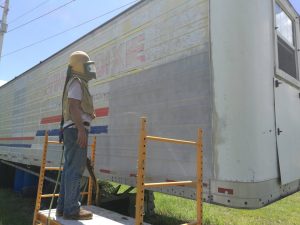
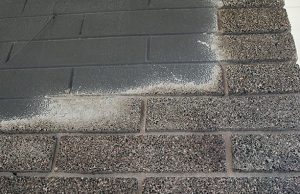
And do the blasting under proper containment with proper respiratory protection. Abrasive blasting throws respirable dust, and depending on what is coming off the part it can throw worse than dust. OSHA’s abrasive blasting guidance is the plain-language version of why this is not a driveway project with a rented hopper.
When we will tell you not to hire us
If you have four small brackets with light surface rust and a coater across town who does their own in-house prep, let them handle it. Moving parts twice to save a step is not a savings.
If the part is new hot-rolled steel with tight, intact mill scale and it is going into a mild indoor service life, some coaters are set up to handle that themselves chemically. Ask them first.
And if the steel is pitted through, cracked, or the frame is compromised, blasting it will only confirm what it already told you. A welder is the right call before a blaster is. We would rather say so at the gate than take your money and hand you a beautifully prepped piece of scrap.
What we do and what we do not
To be straight about it: we are the surface prep half of this. We blast, we match the standard and the profile, we deliver bare clean steel on a schedule that respects flash rust, and we work with whatever powder coater you use. We do not powder coat in house. What we do offer on the coating side is conventional liquid painting and coating services in Ocala — primer and topcoat, same crew, same day, which for a lot of farm and trailer steel is honestly the more practical route than trucking parts to an oven.
We serve Ocala, Belleview, Silver Springs, Anthony, Summerfield, Dunnellon, Marion Oaks and the rest of Marion County. Barn aisles, arenas, shop floors, roadside gate entrances — the rig comes to you.
Need sandblasting in Ocala or nearby? Call (352) 723-0181 for a free on-site estimate. You will reach someone who actually does the work.